Basic Dimension
.jpg)

.png)

.png)
.png)
At 10 km altitude there is no air resistance from the bow wave of the aircraft to interfere with the sum vector. But maybe there's a sticking effect from the hull on shrapnel. Not directly but more along the fuselage. May be visible on the roof of the aircraft. Not my profession anyway. I don't know.
But it is certainly possible that the hull places itself somewhat under the shrapnel by its 900km/h speed. This by increasing the perpendicular frac speed of shrapnel in the sum vector, relatively to the airplane:
.png)
2000 m/sec = 120 km/min = 7200 km/h. (speed of shrapnel).
7200 + 900 (MH17) = 8100 km/h (resulting perpendicular relative speed of shrapnel).
So, we must add 900 km/h from MH17 to the shrapnel speed, insofar this is in line with the direction of the airplane. We simply increase relative blast speed from 2000m/sec to 8100 km/h, which also means the warhead explodes in a smaller oval on the left side of the cockpit, something like that.
And below we increase missile speed relatively:
.png)
.png)
.png)
http://d1.scribdassets.com/ScribdViewer.swf?document_id=284722224&access_key=key-qtfE8MB3HxMrZ1r7qtZI
http://www.whathappenedtoflightmh17.com/questions-for-dsb-having-no-answers-in-final-report/#comment-12311
 Basic Dimension // November 20, 2015 at 1:00 pm //
 Range differences between warhead 9N314 and 9N314M
The main problem of warheads is overshoot of small fighter aircraft by too early or too late detonation.
Fighter aircraft are fast and so missiles must be much faster. The maximum speed of a BUK-missile is Mach 3 (1000 m/s) on a very short distance. But this speed also is the enemy of precision. And a BUK cannot slow down near the target.
http://tinyurl.com/ogsw8pk

http://tinyurl.com/okb5y6m

Hence, the predecessor of A-A invented a means of firing backwards from the rear part of the warhead: He divided the warhead into two parts. In the back part he placed early exploding bowties and fillers to acquire an angle of more than 90 degrees in case of late detonation. And at front of the warhead he placed cubes, bowties and fillers which fired forwards for a sharper angle by early detonation.
 Antidyatel // January 4, 2016 at 3:54 am //
Guys. Cubes have all three sides equal. I know that it is easiest to write cubes than parrallelipipids. But 13x13x8 just sounds very funny.
Good work otherwise.;)
Do you have a link to summarised spread pattern from A-A explosion trials.
Good work otherwise.;)
Do you have a link to summarised spread pattern from A-A explosion trials.
Wind Tunnel Man:
[If the 8x8x5 fragments are packed only into the forward portion of a 9N314 warhead perhaps we would expect mainly 13x13x8 fragments to be in the rearmost portion of the fragmentation spread?]
I assume the warhead explodes a meter earlier than expected from the angles of impact. Then 8x8x5 little cubes admittedly are packed in the forward portion of a 9N314, but despite less time to travel, they will be quicker at the windshield then big cubes (13x13x8).
Despite 13x13x8 big cubes are slower they have somewhat more time for arrival at the windshield. Hence I expect, both will arrive, but big cubes somewhat later.
[If that is correct and the frag spread characteristics are very similar to those of a 9N314M as described by A-A then any speed differential between fragments of the same size and weight would be minimal when they impacted the limited area of front port side windows.]
As said, lighter little cubes will arrive sooner at the windshield.
[Also if the window area was hit by 13x13x5 cubes (13x13x8 cubes), that are possibly the main constituents forming the rear of a 9N314 frag spread, perhaps one would expect to see mostly impact marks and penetrations that one could attribute to that size of shrapnel?]
No, because little cubes (8x8x5) need less time to expand as far as big cubes (13x13x8), which need more time. And little cubes will arrive sooner.
But remember, it might be bowties (13x13x8.2) from 9N314M and big cubes (13x13x8) from 9N314 do not expand enough to reach the front port window, despite an extra meter.
So I would expect more fillers (6x6x8.2) and little cubes (8x8x5) from 9N314M and more little cubes (8x8x5) from 9N314 at the left port windshield. I would expect less heavy shrapnel.
 unit0 // April 17, 2016 at 4:15 pm //
The best picture id DSB report for search blast point is it:
http://s05.radikal.ru/i178/1604/64/2ea5989fdd1e.png
I see 2 focus point. It is very right. Heavy(slow) and light(fast) fragments of warhead must get different blust position, because Boeing have non zero speed.
[At this stage of our investigation I tend to favor a 9N314M simply because of the high proportion of small impact marks and penetrations that may have been caused by 6x6x8.2 filler cubes that we see in the forward port side windows area.]
I cannot agree. Maybe we better determine the size of the holes in the windshield and their angle of detonation through this shield.
[If the 8x8x5 fragments are packed only into the forward portion of a 9N314 warhead perhaps we would expect mainly 13x13x8 fragments to be in the rearmost portion of the fragmentation spread?]
I assume the warhead explodes a meter earlier than expected from the angles of impact. Then 8x8x5 little cubes admittedly are packed in the forward portion of a 9N314, but despite less time to travel, they will be quicker at the windshield then big cubes (13x13x8).
Despite 13x13x8 big cubes are slower they have somewhat more time for arrival at the windshield. Hence I expect, both will arrive, but big cubes somewhat later.
[If that is correct and the frag spread characteristics are very similar to those of a 9N314M as described by A-A then any speed differential between fragments of the same size and weight would be minimal when they impacted the limited area of front port side windows.]
As said, lighter little cubes will arrive sooner at the windshield.
[Also if the window area was hit by 13x13x5 cubes (13x13x8 cubes), that are possibly the main constituents forming the rear of a 9N314 frag spread, perhaps one would expect to see mostly impact marks and penetrations that one could attribute to that size of shrapnel?]
No, because little cubes (8x8x5) need less time to expand as far as big cubes (13x13x8), which need more time. And little cubes will arrive sooner.
But remember, it might be bowties (13x13x8.2) from 9N314M and big cubes (13x13x8) from 9N314 do not expand enough to reach the front port window, despite an extra meter.
So I would expect more fillers (6x6x8.2) and little cubes (8x8x5) from 9N314M and more little cubes (8x8x5) from 9N314 at the left port windshield. I would expect less heavy shrapnel.
unit0 // April 17, 2016 at 4:15 pm // The best picture id DSB report for search blast point is it:
http://s05.radikal.ru/i178/1604/64/2ea5989fdd1e.png
I see 2 focus point. It is very right. Heavy(slow) and light(fast) fragments of warhead must get different blust position, because Boeing have non zero speed.
[At this stage of our investigation I tend to favor a 9N314M simply because of the high proportion of small impact marks and penetrations that may have been caused by 6x6x8.2 filler cubes that we see in the forward port side windows area.]
I cannot agree. Maybe we better determine the size of the holes in the windshield and their angle of detonation through this shield.
http://tinyurl.com/p5kygsq


http://tinyurl.com/oxxy56l

Since the detonation point is on minimal distance from the jet, the sum vector needs an angle of 90 degrees or more to fire backwards. That's the sophisticated strategy of warhead 9N314M. And look at the DSB model: bowties and fillers are firing backwards:

With an exhausted missile very far from Snizhne and a big passenger aircraft, warhead 9N314M definitely was not needed. So, if the Russians deliberately shot down MH17 from S. they never would have used 9N314M but 9N314.
[https://www.youtube.com/watch?v=rG0Bi_wf7JM]
http://tinyurl.com/p458ahk
https://www.facebook.com/media/set/?set=a.10152730368719364.1073741861.723364363&type=3


http://tinyurl.com/o6v2ns7

On the other hand, if someone intentionally shot down MH17 from Zaroshchenske he could have used 9N314M, for it was a very short distance with a big risk of overshoot. But again with a very big passenger plane even a 9N314 would not miss:
http://tinyurl.com/qz5oqk2

http://tinyurl.com/pssa42o

http://tinyurl.com/qg5vpb7

http://www.whathappenedtoflightmh17.com/this-is-how-dsb-determined-the-location-of-explosion-of-the-buk-missile/#comment-17031
The 9N314M warhead has a couple of characteristics which determine the damage pattern on the warhead.
- the shape of the warhead. The warhead is barrelshaped. This leads to a certain minimum ejection angle and maximum ejection angle.
- the location of the detonator. This determines the ejection angle. If the detonator is located in the front of the warhead, fragments will be pushed out more backwards then when using a detonator located in the back or middle
- preformed fragments. The 9N413M warhead has preformed fragments. This means each fragment has a distinct shape and is put loose into the warhead in a pattern. The alternative is pre-ready fragments. In this situation the fragments are not loose but are fixed to eachother. The force of the explosion creates random shaped fragments.
- weight of the fragments. Heavy fragments have higher speed of the explosion due to the kinetic energy. Higher speed of the fragment combined with the speed of the missile mean a different distribution of fragments compared to light fragments.
- number of light and heavy fragments
http://www.un.org/disarmament/un-saferguard/gurney/
(Enter: cyclotol, 33, 37, cylindrical. AFAIK Buk warhead uses a TNT/RDX mix)
The Launch Spot
http://www.whathappenedtoflightmh17.com/this-is-how-dsb-determined-the-location-of-explosion-of-the-buk-missile/#comment-17031

 Charles Wood // April 26, 2016 at 12:57 am //
I’m curious why all models assume a launch from the South.
What specific reasons exclude the missile being launched from the north on a reverse track?
I assume the damage pattern would be very similar?
What specific reasons exclude the missile being launched from the north on a reverse track?
I assume the damage pattern would be very similar?
Eugene // April 26, 2016 at 1:11 am //
This is a good question. It is possible to make practically the same side-arm of the shrapnel beam with a missile coming from the other direction. The difference is that the rear-facing jet of shrapnel is much less intense that the forward one. This is because the missile speed is subtracted from shrapnel speed and because the forward spray is much more intense due to the warhead firing slightly backwards (if we take Buk). The conservation of momentum says that the forward bit of the missile needs to be intensely thrown forward to compensate for the warhead shooting slightly backwards. As we see quite a lot of damage on the left wing, it is more likely that the missile came from ahead or right.
 Basic Dimension // January 4, 2016 at 12:58 pm //
Wind Tunnel Man:
[Do you think a 9N314 warhead has a similar “scalpel/lancet” fragmentation spread to that of a 9N314M warhead as described by A-A? A 9N314M warhead has 4100 + 1870 smaller striking elements and a 9N314 has 4740 smaller striking elements. The 1870 “bow-ties” of a 9N314M also weigh less individually than the 1790 13x13x8 cubes of a 9N314.]
How would I know? I got all my information from you
A 9N314 warhead has 27 % heavy parallelepiped (13x13x8) and a 9N314M has 24 % heavy bowties (13x13x8.2). I think the weight differences are marginal just like the proportions from total amount of shrapnel.
If this would be true:
[If the 8x8x5 fragments are packed only into the forward portion of a 9N314 warhead perhaps we would expect mainly 13x13x8 fragments to be in the rearmost portion of the fragmentation spread?]
Then heavy parallelepiped (13x13x8) would hit later and eventually totally miss the left port windshield. But they have somewhat more time to arrive on the target.
In 9N314M, bowties are placed everywhere meaning the same: we do not expect many bowties in the front left port windshield, since they are too slow.
Heavy shrapnel resides in the inner radius of the lancet. But maybe bowties in the back part of 9N314M are fired backwards so they reach the target in the backlash with more time.
[Do you think a 9N314 warhead has a similar “scalpel/lancet” fragmentation spread to that of a 9N314M warhead?]
Yes if the radius would be projected on the wall, but not on the time dimension.
I think we first must understand why they replaced 9N314 by 9N314M:
[Eugene: – DSB has n’t noticed that the geometric shape of the warhead [9N314M] contained two segments, not one: one fully convex (barrel-like), and another is concave on the chord direction. Again they haven’t been much troubled by the fact that the model they’ve fed into their simulator was different from the real thing.]
IMO they invented 9N314M to enlarge the fract spread range on the target:
[Range differences between warhead 9N314 and 9N314M.
The main problem of warheads is overshoot of small fighter aircraft by too early or too late detonation.
Fighter aircraft are fast and so missiles must be much faster. The maximum speed of a BUK-missile is Mach 3 (1000 m/s) on a very short distance. But this speed also is the enemy of precision. And a BUK cannot slow down near the target.
So what is the problem of a BUK-missile? It is the sum vector formed by the frac speed vector (2000 m/s; Mach 6) and the speed of the missile (1000 m/s; Mach 3), by which the fast missile might fire behind the fighter jet from a too sharp angle.
Hence, the predecessor of A-A invented a means of firing backwards from the rear part of the warhead: He divided the warhead into two parts. In the back part he placed early exploding bowties and fillers to acquire an angle of more than 90 degrees in case of late detonation. And at front of the warhead he placed cubes, bowties and fillers which fired forwards for a sharper angle by early detonation.
Conclusion: The overall strategy of a 9N314M is to broaden the range of the blast compared to 9N314. The range had to be broadened since the reach of the frac speed vector itself is extremely short and the point of detonation is almost on the fighter jet.]
Hence the “scalpel/lancet” fragmentation spread will be comparable in the lancet but will have very different effects on the target. The projection on the wall will be the same but in 9N314M the lancet will be stretched in time.
Remember good old AD who gave a very interesting opinion in Metabunk:
https://www.metabunk.org/almaz-anteys-live-buk-explosion-tests.t6903/
Inner layer contain 1870 bow-tie heavy strike elements with 1870 filler strike elements between them.
Outer layer contain 4100 square strike elements.
Layers isolated from explosive filling, between them and from open air with textile.
During explosion inner layer work as liner and prevent gas leaking at first moment. Elements of inner layer have outnourmos thermal and pressure stress from explosion from one side. At same time inner layer exchange energy with outer layer, it is adding stress to inner elements from another side.
As result bow-tie elements start to lose shape and receive oblateness.
In extreme cause bow-tie elements can even lose shape completely and decay on 2 debris. It happen if bow-tie element situated in area with highest pressure – middle of warhead (in really this area start approx. at 1/4 and continue to 3/4 of warhead length).
Very interesting why inner layer contain bow-tie elements, instead of old design with only square elements (heavy and light).
Technically, square elements have very good penetration on high speed – sharp edge can “cut” target material with lower density. Also square have best ratio weight/size. But warhead 9N314M lose heavy strike elements – square, during development. Why it happen despite on square penetartion?
As im said – inner layer work as liner for outer layer during explosion. Liner prevent gas leaking during time when elements receive acceleration from explosive force as gas pressure per square. Very important on this stage prevent destruction (decay or mis-shape with holes between nearby elements) for elements which isolate gas. Previous design with square elements reveal a problem – square under stressing pressure start to exploding in size. As any metal – direction of this exploding depend from lowest density. Lowest density happen on edge. Cube/Square exploding on edges and become as flatten sphere. Spheres have holes for gas leaking between them, also shpere have lesser penetration. Outnormous pressure during explosion can even destroy square on a few debris which can be too small for penetrate armored targets (main idea of heavy strike elements is penetration of armored targets like close-support war plane Su-25 or A-10).
All these troubles solved with new design exchanged square heavy elements for bow-tie elements.
Bow-tie shape still have weight and sharp edges but more protected from sphere exploding (bow-tie have lesser length of edges so density not so low). That mean layer with bow-tie transmit more energy to outer layer before gas leaking play role. Also bow-tie elements even when decay on a few debris produce only one main big debris with little losing of weight or two debrises with almost half of weigth each. This is enough for designed effect – penetration of armored targets.
How good bow-tie layer as liner? Outer layer receive speed up to 2400 m/s. It have only a few difference from Gurney equation fragment speed (maximum speed which can receive strike element for warhead case shape, weight ratio, explosive) near 3000-3100 m/s.
For example, inner layer with bow-tie lose some many energy in exchange and after it receive additional force from explosion only when gas-leaking happen so bow-tie strike elements receive almost half of inner layer speed – near 1200-1800 m/s.
Conclusion – bow-tie elements will lose shape in most causes so Almaz-Antey slide with typical hole is manipulation and lie.
[Do you think a 9N314 warhead has a similar “scalpel/lancet” fragmentation spread to that of a 9N314M warhead as described by A-A? A 9N314M warhead has 4100 + 1870 smaller striking elements and a 9N314 has 4740 smaller striking elements. The 1870 “bow-ties” of a 9N314M also weigh less individually than the 1790 13x13x8 cubes of a 9N314.]
How would I know? I got all my information from you
A 9N314 warhead has 27 % heavy parallelepiped (13x13x8) and a 9N314M has 24 % heavy bowties (13x13x8.2). I think the weight differences are marginal just like the proportions from total amount of shrapnel.
If this would be true:
[If the 8x8x5 fragments are packed only into the forward portion of a 9N314 warhead perhaps we would expect mainly 13x13x8 fragments to be in the rearmost portion of the fragmentation spread?]
Then heavy parallelepiped (13x13x8) would hit later and eventually totally miss the left port windshield. But they have somewhat more time to arrive on the target.
In 9N314M, bowties are placed everywhere meaning the same: we do not expect many bowties in the front left port windshield, since they are too slow.
Heavy shrapnel resides in the inner radius of the lancet. But maybe bowties in the back part of 9N314M are fired backwards so they reach the target in the backlash with more time.
[Do you think a 9N314 warhead has a similar “scalpel/lancet” fragmentation spread to that of a 9N314M warhead?]
Yes if the radius would be projected on the wall, but not on the time dimension.
I think we first must understand why they replaced 9N314 by 9N314M:
[Eugene: – DSB has n’t noticed that the geometric shape of the warhead [9N314M] contained two segments, not one: one fully convex (barrel-like), and another is concave on the chord direction. Again they haven’t been much troubled by the fact that the model they’ve fed into their simulator was different from the real thing.]
IMO they invented 9N314M to enlarge the fract spread range on the target:
[Range differences between warhead 9N314 and 9N314M.
The main problem of warheads is overshoot of small fighter aircraft by too early or too late detonation.
Fighter aircraft are fast and so missiles must be much faster. The maximum speed of a BUK-missile is Mach 3 (1000 m/s) on a very short distance. But this speed also is the enemy of precision. And a BUK cannot slow down near the target.
So what is the problem of a BUK-missile? It is the sum vector formed by the frac speed vector (2000 m/s; Mach 6) and the speed of the missile (1000 m/s; Mach 3), by which the fast missile might fire behind the fighter jet from a too sharp angle.
Hence, the predecessor of A-A invented a means of firing backwards from the rear part of the warhead: He divided the warhead into two parts. In the back part he placed early exploding bowties and fillers to acquire an angle of more than 90 degrees in case of late detonation. And at front of the warhead he placed cubes, bowties and fillers which fired forwards for a sharper angle by early detonation.
Conclusion: The overall strategy of a 9N314M is to broaden the range of the blast compared to 9N314. The range had to be broadened since the reach of the frac speed vector itself is extremely short and the point of detonation is almost on the fighter jet.]
Hence the “scalpel/lancet” fragmentation spread will be comparable in the lancet but will have very different effects on the target. The projection on the wall will be the same but in 9N314M the lancet will be stretched in time.
Remember good old AD who gave a very interesting opinion in Metabunk:
https://www.metabunk.org/almaz-anteys-live-buk-explosion-tests.t6903/
Inner layer contain 1870 bow-tie heavy strike elements with 1870 filler strike elements between them.
Outer layer contain 4100 square strike elements.
Layers isolated from explosive filling, between them and from open air with textile.
During explosion inner layer work as liner and prevent gas leaking at first moment. Elements of inner layer have outnourmos thermal and pressure stress from explosion from one side. At same time inner layer exchange energy with outer layer, it is adding stress to inner elements from another side.
As result bow-tie elements start to lose shape and receive oblateness.
In extreme cause bow-tie elements can even lose shape completely and decay on 2 debris. It happen if bow-tie element situated in area with highest pressure – middle of warhead (in really this area start approx. at 1/4 and continue to 3/4 of warhead length).
Very interesting why inner layer contain bow-tie elements, instead of old design with only square elements (heavy and light).
Technically, square elements have very good penetration on high speed – sharp edge can “cut” target material with lower density. Also square have best ratio weight/size. But warhead 9N314M lose heavy strike elements – square, during development. Why it happen despite on square penetartion?
As im said – inner layer work as liner for outer layer during explosion. Liner prevent gas leaking during time when elements receive acceleration from explosive force as gas pressure per square. Very important on this stage prevent destruction (decay or mis-shape with holes between nearby elements) for elements which isolate gas. Previous design with square elements reveal a problem – square under stressing pressure start to exploding in size. As any metal – direction of this exploding depend from lowest density. Lowest density happen on edge. Cube/Square exploding on edges and become as flatten sphere. Spheres have holes for gas leaking between them, also shpere have lesser penetration. Outnormous pressure during explosion can even destroy square on a few debris which can be too small for penetrate armored targets (main idea of heavy strike elements is penetration of armored targets like close-support war plane Su-25 or A-10).
All these troubles solved with new design exchanged square heavy elements for bow-tie elements.
Bow-tie shape still have weight and sharp edges but more protected from sphere exploding (bow-tie have lesser length of edges so density not so low). That mean layer with bow-tie transmit more energy to outer layer before gas leaking play role. Also bow-tie elements even when decay on a few debris produce only one main big debris with little losing of weight or two debrises with almost half of weigth each. This is enough for designed effect – penetration of armored targets.
How good bow-tie layer as liner? Outer layer receive speed up to 2400 m/s. It have only a few difference from Gurney equation fragment speed (maximum speed which can receive strike element for warhead case shape, weight ratio, explosive) near 3000-3100 m/s.
For example, inner layer with bow-tie lose some many energy in exchange and after it receive additional force from explosion only when gas-leaking happen so bow-tie strike elements receive almost half of inner layer speed – near 1200-1800 m/s.
Conclusion – bow-tie elements will lose shape in most causes so Almaz-Antey slide with typical hole is manipulation and lie.
 Wind tunnel man // November 17, 2015 at 12:23 am //
Basic Dimension:
“…confirming A-A becomes a problem without an exactly known distribution on the radial of the lancet. Please tell us how the theory of the lancet works. Here we first must agree before we can conclude.”
https://www.youtube.com/watch?v=GsohFzbJ-vs – there is some information from 13 minutes and 30 seconds in the video. Unfortunately no details regarding the nature of the detonation – just the subsequent form of the lancet.
Thanks for correcting my error when I wrote “a mix of 3 types of distinct penetrations: by bow-ties, filler cubes and cubes if a 9N314 [sic: 9N314M] warhead had been used.” I’m sorry if it caused any confusion.


 sotilaspassi // April 22, 2016 at 1:50 pm //
Some things from thoughts …
Detonation close vs far, movement vs no movement etc.
https://drive.google.com/file/d/0BxNz0P5oVk2wWTVFU1c3MkRScEU
Detonation close vs far, movement vs no movement etc.
https://drive.google.com/file/d/0BxNz0P5oVk2wWTVFU1c3MkRScEU

 Brendan // May 16, 2016 at 7:14 pm //
If the velocities of the fragments and the target are assumed to be constant, the stringing method will not be affected by any of those factors that you mention. Straight lines on a static diagram can then represent the path of each fragment back to where it was fired from.
The path lines will only be curved where there is acceleration or deceleration. The fragments do accelerate for some time at the start of their trajectory when the explosive propels them from the warhead. However that’s only for a fraction of a millisecond, which is much less than the total travel duration of several milliseconds towards the marks found on MH17.
At one time I thought that all the different speeds, directions and distances of the different fragments, and also of the aircraft, might cause the grazing marks to point to different locations of the detonation. I’ve figured out now that it’s much simpler than that and that the stringing method is very accurate.
The path lines will only be curved where there is acceleration or deceleration. The fragments do accelerate for some time at the start of their trajectory when the explosive propels them from the warhead. However that’s only for a fraction of a millisecond, which is much less than the total travel duration of several milliseconds towards the marks found on MH17.
At one time I thought that all the different speeds, directions and distances of the different fragments, and also of the aircraft, might cause the grazing marks to point to different locations of the detonation. I’ve figured out now that it’s much simpler than that and that the stringing method is very accurate.
Eugene // November 17, 2015 at 2:06 pm //
The poetic mind of Basic Dimension cannot get the simple idea that if the fragments did not spin they’d be flying in the original formation, and thus every hole on the target could be traced to the fragment on the warhead. But in reality the picture is more chaotic than that.
Again, why the fragments spin:
-The detonation wave front is not that uniform.
-The detonation wave front approaches the wall at an angle, so a force starts pushing on one side of each fragment first.
-The fragments are held in a strong compound that needs to break. There is no way that the breaking of the compound will be smooth and uniform.
-In general, it is hard to push little things without inducing rotation. The physical reason being that the inertia depends on size (r) as r^5, while torques due to the non-uniformity are roughly proportional to r^3. As things get smaller the inertia gets smaller a lot faster than the torques.
-The detonation wave front is not that uniform.
-The detonation wave front approaches the wall at an angle, so a force starts pushing on one side of each fragment first.
-The fragments are held in a strong compound that needs to break. There is no way that the breaking of the compound will be smooth and uniform.
-In general, it is hard to push little things without inducing rotation. The physical reason being that the inertia depends on size (r) as r^5, while torques due to the non-uniformity are roughly proportional to r^3. As things get smaller the inertia gets smaller a lot faster than the torques.
Wind tunnel man // November 17, 2015 at 4:33 pm //
Eugene:
“The poetic mind of Basic Dimension cannot get the simple idea that if the fragments did not spin they’d be flying in the original formation, and thus every hole on the target could be traced to the fragment on the warhead. But in reality the picture is more chaotic than that.”
TNO (pages 19 and 20 appendix y DSB report) seemed to suggest that the warhead’s fragments when projected onto a target would resemble their positions on the warhead – they used the analogy of a wooden barrel’s circumference and staves to indicate a “regular holes pattern.” Also they used the pitch between the same type of fragment impact marks to determine the range, i.e. the divergence of fragments over distance (page 10.)
In TNO’s view does that suggest a significantly chaotic event? Also if the fragments were tumbling at a very high rate then they would tend to drill holes rather than punch holes. Certainly some tumbling can not be discounted but even with minimal tumbling/rotation any penetration holes should still be identifiable if they were made by either cube or bow-tie shaped fragments. A bow-tie fragment in most orientations penetrating a target at various angles would probably leave evidence of it’s shape, though obviously in many instances not necessarily a perfect bow-tie shaped puncture.
Eugene // November 17, 2015 at 5:25 pm //
TNO can say whatever they want. They’ve proved that they were not particularly troubled by fact that it does not match the reality. Here are a couple of examples:
– The spread pattern they calculated with the help of Split-X contained a reasonably sized gap. They apparently were not troubled by the fact that the gap was not observed on the wreckage.
-They haven’t noticed that the geometric shape of the warhead contained two segments, not one: one fully convex (barrel-like), and another is concave on the chord direction. Again they haven’t been much troubled by the fact that the model they’ve fed into their simulator was different from the real
thing.
thing.
-My best understanding of the matching methods they’ve used (as far as I could understand from their vague language) lets me believe that the results they’ve obtained were very sensitive to the shrapnel spread angles. Therefore feeding a wrong warhead geometry would have a significant impact on the results. Again, they didn’t bother considering that. (Not delving into the fact that the stringing methods should have been used as being a lot more specific).
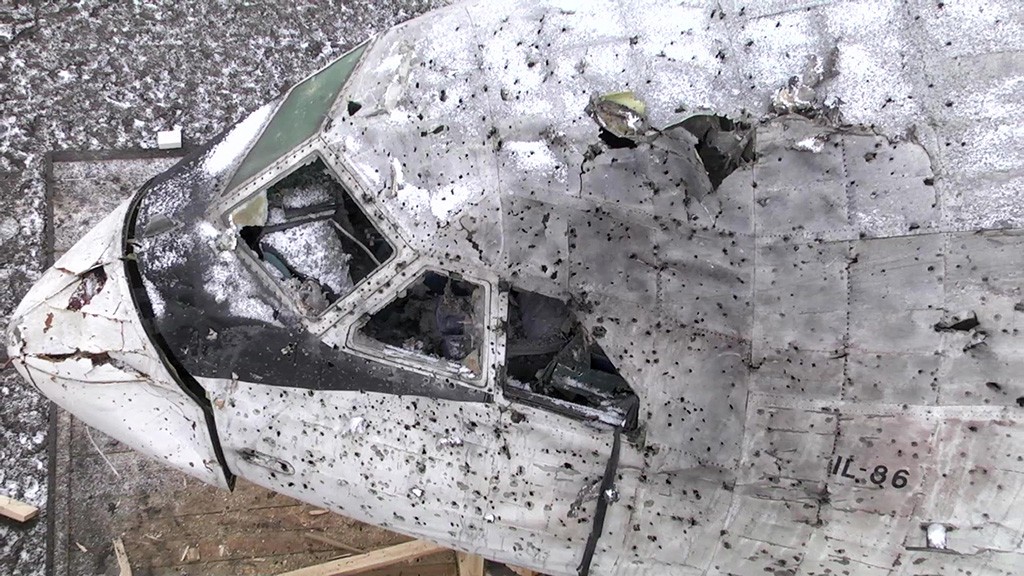
Given above, instead of taking the TNO’s words, it is by far the safest way to just look at the results of the real-life experiment by AA. Do you see regular patterns of holes on Il-86? Even if lines can sometimes be perceived they are not pronounced. Mostly it’s just a random spray.
Fragments don’t spin enough to drill. But probably enough to do a couple of revolutions before hitting. Here, to be honest, it’s hard to estimate the amount, a high speed footage would be needed. But, honestly, I strongly believe they do spin, and therefore all hit the target at different orientations.
- Eugene:Please remember the static test done by A-A on the IL-86 didn’t allow their claimed “lancet” to be formed within the frag spread hence it probably does look like a “random spray”. TNO considered a moving missile and how fragments might be propelled onto a moving target. That would change the fragment distribution and if a “lancet” did form then the varying concentration of, and the pattern of impacts, would possibly be apparent.When TNO say “In reality the fragment velocity leap will be less sudden, so that the two strips with fragment impacts will merge into each other” (page 19) are they confirming the “lancet” characteristics within the frag spread claimed by A-A when a missile is moving at speeds in excess of 600m/s?I agree that they did use a different design model to that given by A-A (design II rather than design III – see page 15) but they noted the main difference was the “angular range for the fragment ejection.”Sorry I’m going to use a bullet analogy again: a tumbling bullet can leave a distinct hole in a target. If it is not tumbling too rapidly and has, at the moment of impact, rotated through 90 degrees relative to it’s longitudinal axis but still travelling in the same direction it will punch a clean hole resembling it’s shape. A bullet tumbling more rapidly will pierce through a target and leave a ragged indistinct hole.Bow-tie strike elements. Why it lose shape even before penetration.
Annex 1:
Warhead 9N314M has 2 layers of strike element.Last edited: Oct 15, 2015
Alternative Theories – The Almaz-Antey Press Conference
On June 2, 2015 Russian arms manufacturer Almaz-Antey presented evidence claiming to show the specific type of missile used to shoot down MH17 in Ukraine. They were quoted as stating:[51]If a surface-to-air missile system was used [to hit the plane], it could only have been a 9M38M1 missile of the BUK-M1 system.They went on to add:
Production of BUK-M1 missiles was discontinued in 1999, at the same time Russia passed all such missiles that were left to international clients.The clear implication was that the Buk missile used to shoot down MH17 could have not come from Russia. The most obvious visual difference between the 9M38M1 missile, and the newer 9M317 is the length of the fins, with the 9M38M1 having longer fins, as visible below.

http://www.whathappenedtoflightmh17.com/what-ricochet-damage-can-reveal-on-the-location-of-the-warhead/#comment-14536
 Eugene // January 15, 2016 at 2:17 am //
Davie, thanks for clarification. People here do often realise that their use of terminology is quite loose. What is the best term to collectively call the blast products such as fragments and the bits of the missile body? It is often impossible to tell whether a hole was made by one or the other, so we need a collective term for hard flying objects.
> The possibility of ricochet in this case in unlikely due to the comparatively soft skin.
Unless the incident angle is almost zero – a grazing trajectory.
I pointed this out before, but you haven’t joined the site then. It’s worth repeating: the higher the speed of the projectile the more well-defined the resulting hole edge/boundary. For very fast hitting speeds the holes will look like they’ve been burned through, without much deformation of the target.
Examples:
a shaped charge holes: http://s00.yaplakal.com/pics/pics_preview/1/2/6/582621.jpg
http://www.apacheclips.com/files/0ae13939d19a.jpg
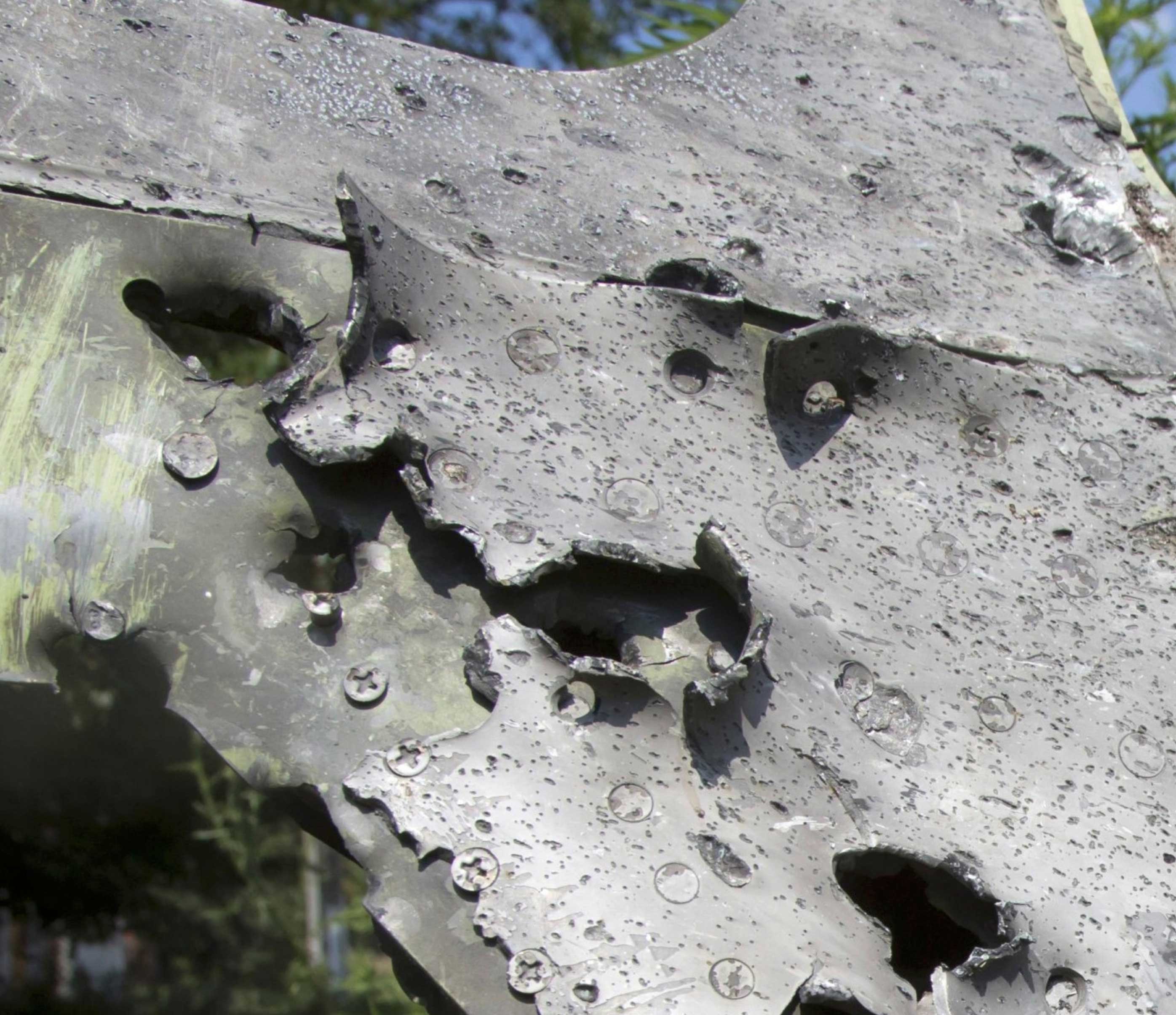
the bow-tie holes on the Il-86: http://savepic.su/6411148.jpg
On the other hand, a lower hit speed will result in more bent and torn edges. Examples:
bullet holes:
http://www.whathappenedtoflightmh17.com/wp-content/uploads/2014/09/bullets.png
http://img12.deviantart.net/3940/i/2012/108/c/3/bullet_hole_by_roverjunkie-d4wmfr3.jpg
http://www.milcentric.com/wp-content/uploads/2012/12/Bullet-Hole-Ring-1.jpg
The alleged right hand side exit hole on mh17 (that no-one knows where it is on the plane body): http://www.whathappenedtoflightmh17.com/wp-content/uploads/2015/10/exitdamage.png
or entry holes on mh17: https://a.disquscdn.com/uploads/mediaembed/images/1189/8709/original.jpg
The physical reason for this effect is the following: on a high hitting speed the interaction time of a projectile and a target is smaller than on a slow hitting speed, allowing less target material to get involved in the process. Therefore on high speeds there will be less bending and tearing, and the shape of the hole will match the the shape of the projectile better. On a slow speed, on the other hand, the elastic propagation will have an opportunity to distribute the energy wider (i.e. the phonons will bounce off more and reach further, for you physicists out there) and thus a greater area of the target will participate in the interaction.
Here is an alternative explanation: on a higher speed the collision forces are higher. For extremely high collision forces the inertial properties of the material become more important than the elastic properties. This is indeed the case, as a penetration of a shaped charge jet into an armour is often modelled as a penetration of a fluid jet into a fluid target (=ignoring any elastic properties/intrinsic strength), giving sufficiently good results. On such speeds the strength of an armour becomes almost irrelevant (for some hard ceramics it is not fully the case though), and the only thing that matters is the density. That’s why Abrams tanks sometimes use depleted uranium armour and depleted uranium projectiles.
Davie, if you are a specialist in the field of ballistics or related, could you tell your opinion on my observation that the holes on Il-86 look like they have been made by higher speed fragments than the holes on mh17? AA actually voiced their finding that on Il-86 there were almost no ricochets, just as should be for very high hitting speeds. But on MH17 we notice more ricochets, and the hole edges are more bent and torn, often looking crown-like. (Leaving aside the issue that there are plenty of bowtie shaped holes on Il-86, and none on Mh17)
Compare
Il-86:
http://cdn.tvc.ru/pictures/o/185/319.jpg
https://pbs.twimg.com/media/CRXKtJ8U8AA65x5.jpg:large
http://kr.sputniknews.com/images/70/86/708667.jpg
http://savepic.su/6411148.jpg
https://www.metabunk.org/attachments/83b107d1ce402bf18ad1b663a0cd8269-png.15581 (not exactly on Il-86, but by a Buk)
Mh17:
https://niqnaq.files.wordpress.com/2014/07/14769648553_beae8c1a94_o.jpg
> The possibility of ricochet in this case in unlikely due to the comparatively soft skin.
Unless the incident angle is almost zero – a grazing trajectory.
I pointed this out before, but you haven’t joined the site then. It’s worth repeating: the higher the speed of the projectile the more well-defined the resulting hole edge/boundary. For very fast hitting speeds the holes will look like they’ve been burned through, without much deformation of the target.
Examples:
a shaped charge holes: http://s00.yaplakal.com/pics/pics_preview/1/2/6/582621.jpg
http://www.apacheclips.com/files/0ae13939d19a.jpg
the bow-tie holes on the Il-86: http://savepic.su/6411148.jpg
On the other hand, a lower hit speed will result in more bent and torn edges. Examples:
bullet holes:
http://www.whathappenedtoflightmh17.com/wp-content/uploads/2014/09/bullets.png
http://img12.deviantart.net/3940/i/2012/108/c/3/bullet_hole_by_roverjunkie-d4wmfr3.jpg
http://www.milcentric.com/wp-content/uploads/2012/12/Bullet-Hole-Ring-1.jpg
The alleged right hand side exit hole on mh17 (that no-one knows where it is on the plane body): http://www.whathappenedtoflightmh17.com/wp-content/uploads/2015/10/exitdamage.png
or entry holes on mh17: https://a.disquscdn.com/uploads/mediaembed/images/1189/8709/original.jpg
The physical reason for this effect is the following: on a high hitting speed the interaction time of a projectile and a target is smaller than on a slow hitting speed, allowing less target material to get involved in the process. Therefore on high speeds there will be less bending and tearing, and the shape of the hole will match the the shape of the projectile better. On a slow speed, on the other hand, the elastic propagation will have an opportunity to distribute the energy wider (i.e. the phonons will bounce off more and reach further, for you physicists out there) and thus a greater area of the target will participate in the interaction.
Here is an alternative explanation: on a higher speed the collision forces are higher. For extremely high collision forces the inertial properties of the material become more important than the elastic properties. This is indeed the case, as a penetration of a shaped charge jet into an armour is often modelled as a penetration of a fluid jet into a fluid target (=ignoring any elastic properties/intrinsic strength), giving sufficiently good results. On such speeds the strength of an armour becomes almost irrelevant (for some hard ceramics it is not fully the case though), and the only thing that matters is the density. That’s why Abrams tanks sometimes use depleted uranium armour and depleted uranium projectiles.
Davie, if you are a specialist in the field of ballistics or related, could you tell your opinion on my observation that the holes on Il-86 look like they have been made by higher speed fragments than the holes on mh17? AA actually voiced their finding that on Il-86 there were almost no ricochets, just as should be for very high hitting speeds. But on MH17 we notice more ricochets, and the hole edges are more bent and torn, often looking crown-like. (Leaving aside the issue that there are plenty of bowtie shaped holes on Il-86, and none on Mh17)
Compare
Il-86:
http://cdn.tvc.ru/pictures/o/185/319.jpg
https://pbs.twimg.com/media/CRXKtJ8U8AA65x5.jpg:large
http://kr.sputniknews.com/images/70/86/708667.jpg
http://savepic.su/6411148.jpg
https://www.metabunk.org/attachments/83b107d1ce402bf18ad1b663a0cd8269-png.15581 (not exactly on Il-86, but by a Buk)
Mh17:
https://niqnaq.files.wordpress.com/2014/07/14769648553_beae8c1a94_o.jpg
Eugene:
Holes on IL-86 must be made by lower speed of fragments than the holes on MH17, since relative velocity between plane and missile must be added. Also bent and torn edges on MH17 must be partly caused by the changed angle of the sum vector of frac speed and missile speed.
So, even if bowties themselves are positioned perpendicular on the hull they still experience additional lateral forces to acute angles.
Consequently, even though speeds are greater in case of MH17 it still looks as if the elastic propagation has more opportunity to distribute the energy wider than with IL-86, what is not the case:
http://tinyurl.com/ogsw8pk
Holes on IL-86 must be made by lower speed of fragments than the holes on MH17, since relative velocity between plane and missile must be added. Also bent and torn edges on MH17 must be partly caused by the changed angle of the sum vector of frac speed and missile speed.
So, even if bowties themselves are positioned perpendicular on the hull they still experience additional lateral forces to acute angles.
Consequently, even though speeds are greater in case of MH17 it still looks as if the elastic propagation has more opportunity to distribute the energy wider than with IL-86, what is not the case:
http://tinyurl.com/ogsw8pk
Antidyatel // January 15, 2016 at 1:12 pm //
Guys. Elastic waves in aluminium is basically speed of sound. By the time fragment with speed above 3000 m/s goes through less than 2 mm Al skin, the sound will travel less than 4 mm. Plus it will propagate along the plane and still need to convert elastic deformation into plastic ones. I don’t understand why do we consider that here. For collision of two bodies we can assume that mass of Al section is much smaller than mass of the fragment. At high-speedsthis assumption is definitely true. There will be practically ellastic collision. Both the fragment and matching section of skin will fly in one direction.
Based on abstract of this paper “https://www.researchgate.net/publication/223629536_Plastic_Deformation_and_Performation_of_Thin_Plates_Resulting_from_Projectile_Impact”
Even 300 m/s will cause full perforation. So I don’t think there should be any plasticity deformed holes.
Eugene // January 15, 2016 at 1:12 pm //
Based on abstract of this paper “https://www.researchgate.net/publication/223629536_Plastic_Deformation_and_Performation_of_Thin_Plates_Resulting_from_Projectile_Impact”
Even 300 m/s will cause full perforation. So I don’t think there should be any plasticity deformed holes.
Eugene // January 15, 2016 at 1:12 pm //
> Holes on IL-86 must be made by lower speed of fragments than the holes on MH17, since relative velocity between plane and missile must be added
My point is that the Il-86 holes look higher speed, while they should look (a bit) lower speed, as you say. I am talking purely about the observation.
And, please, get grip with numbers, at last. The fragment speed in the dynamic case is greater than that of in static test by around mere 6 percent:
sqrt(2400*2400+(600+250)*(600+250))/2400=1.06
It’s not worth bringing that static-vs-dynamic argument again.
My point is that the Il-86 holes look higher speed, while they should look (a bit) lower speed, as you say. I am talking purely about the observation.
And, please, get grip with numbers, at last. The fragment speed in the dynamic case is greater than that of in static test by around mere 6 percent:
sqrt(2400*2400+(600+250)*(600+250))/2400=1.06
It’s not worth bringing that static-vs-dynamic argument again.
 Rob // April 14, 2016 at 5:41 pm //
The 9N314M warhead and the 9M38M1 missile were designed as a weapon against specialized air to ground fighters like the A10-Thunderbolt II, the so called flying tanks. These fighters are most vulnerable from above, that is why the 9N314M is designed to detonate above the fighter. However the older type was designed before these specialized fighters existed, this means the missiles don’t need to follow the same track. Actually they don’t, as the Almaz Antey simulations show. The bowtie was used in the 9N314M because the designers believed they needed a heavier, different shaped fragment to penetrate the armor of a a10 like fighter. Later experiments showed this wasn’t necessary. In newer versions they are no longer used.
unit0 // April 15, 2016 at 4:54 pm //
unit0 // April 15, 2016 at 4:54 pm //
Just in the topic “DSB final report doubts: damage of left wing and left engine nacelle” I wrote the answer, and then I saw this topic on the front page. Perhaps it is appropriate to insert here.
Furthermore, these data are included in direct conflict with the calculations of AA in its presentation.
http://d1.scribdassets.com/ScribdViewer.swf?document_id=284722224&access_key=key-qtfE8MB3HxMrZ1r7qtZI
http://tinyurl.com/z3geery

http://tinyurl.com/h457dxf

http://s017.radikal.ru/i435/1604/c8/3715855bfaa5.png
http://tinyurl.com/jerjs6c

Thanks Sotilaspassi for your correction:

According to these data, 9M38 missile has great energy capabilities than 9M38M1. This is very important nuance.
This is why the DSB lingers with the exact type of missile. Because all of the options are bad.
Rocket 9M38M1 due to a lower speed and larger the angle of inclination at the same distance in the problem of the search starting position shows in the direction of Ukraine. The warhead 9N314 (without bow-tie) also mix the starting point in the direction of Ukraine in calculation.
Option, which is suitable to accuse pro-Russian forces in the downing MH17 – is a chimera, a missile 9M38 with a warhead 9N314M1.
However, the manufacturer (AA) states that such an option was never produced. 9M38 missiles are always equipped with a warhead 9N314, and 9M38M1 rocket always with warhead 9N314M1.
And further, in the Russian missile 9M38 on the application has been removed from service, but still there in the Ukraine.
http://tinyurl.com/hworsr2
.jpg)
https://www.metabunk.org/mh17-missile-plane-intersection-simulation.t6920/
unit0 // April 15, 2016 at 4:54 pm // Reply
This is important information. I first learned missile 9M38M1 (35 km) can make a longer trajectory than 9M38 (24 km):
http://tinyurl.com/hworsr2
But if the reverse is the case, the forced combination of 9M38 (further to Russian border) and 9N314M (bowties) becomes understandable. Can you please give more clarity?
http://tinyurl.com/z3geery
http://tinyurl.com/h457dxf
http://tinyurl.com/jerjs6c

This is important information. I first learned missile 9M38M1 (35 km) can make a longer trajectory than 9M38 (24 km):
http://tinyurl.com/hworsr2
But if the reverse is the case, the forced combination of 9M38 (further to Russian border) and 9N314M (bowties) becomes understandable. Can you please give more clarity?
http://tinyurl.com/z3geery
http://tinyurl.com/h457dxf
http://tinyurl.com/jerjs6c
Unfortunately I have not much detail, I judge according to the presentation of AA.
Range of 24 km for 9M38 shows for a typical target (jet fighter), and can be limited not by the speed of the missile, but guidance systems capabilities.
For example, it can be set to a range which will capture target by missile guidance system. Improved guidance head at 9M38M1 allows you to capture fighters at greater distances, but when shooting at large as a Boeing 9M38 will not have problems with grip, but thanks to the higher speed will provide greater potential distance.
I do not know the correct answer, why according to the AA 9M38 have higher speed and shorter-range missiles to intercept targets at typical. But this is possible.
Range of 24 km for 9M38 shows for a typical target (jet fighter), and can be limited not by the speed of the missile, but guidance systems capabilities.
For example, it can be set to a range which will capture target by missile guidance system. Improved guidance head at 9M38M1 allows you to capture fighters at greater distances, but when shooting at large as a Boeing 9M38 will not have problems with grip, but thanks to the higher speed will provide greater potential distance.
I do not know the correct answer, why according to the AA 9M38 have higher speed and shorter-range missiles to intercept targets at typical. But this is possible.
unit0, thanks for the answer.
I think to grasp the following: 9M38 is outdated with inferior software capabilities to catch jet fighters in comparison with 9M38M1. This means 9M38 needs a strong engine and lots of fuel in real fights and their expected reach is limited to about 24 km.
Modern software in 9M38M1 makes it much easier to catch jet fighters, for example by cutting corners by proportional navigation based on active homing (Line-of-Sight).
[Proportional navigation is the anticipation of the course of the target by timely adjustment of the direction of the missile. Hence, the missile first has an inactive phase of vertical acceleration of the launch, then an active phase of radar guidance by BUK-TELAR or BUK-TAR (Snowdrift) and in the neighbourhood of the target it uses proportional navigation. Since the proximity fuse is still fed by the radar it must be both systems are working together till the end.]
In case 9M38 goes straight to the target from Snizhne, as is the case with MH17, it does not spoil any energy and behaves about as effective as a 9M38M1. Then, 9M38 can be placed more to the Russian border with a reach of about 35 km. So the rationale is 9M38M1 still reaches 35 km, but 9M38 also reaches 35 km because of optimal circumstances.
[The 9M38 missile has a fuel burn time of 15 seconds. After 15 seconds the engine will not provide trust. The 9M38M1 missile has a fuel burn time of 20 seconds.]
Do we now understand the plot below? No:
http://tinyurl.com/jerjs6c
 Rob // April 14, 2016 at 2:16 pm //
 unit0 // April 15, 2016 at 4:31 pm //
 sotilaspassi // May 28, 2016 at 10:01 am //
Furthermore, the Ukrainian construct of a 9M38 with a 9N314M warhead is too contrived for Russian use; it is unnecessary and ridiculous and only shows their intellectual failure to spin a BUK-assault from Snizhne by the Russians.

I think it was about 35 km. So I fear only a 9M38M1 could have done the job from the south of Snizhne. But, as said earlier, this is an impossible scenario. If it was a BUK we must find another launch site more into the direction of MH17. Then it definitely cannot be Russian and it must have been missile 9M38 with warhead 9N314.

Basic Dimension // April 30, 2016 at 11:04 am //

 IsThatSo // April 21, 2016 at 11:12 pm //
http://f-picture.net/lfp/s017.radikal.ru/i408/1604/64/32f2950401e7.png/htm

Eugene // April 21, 2016 at 11:47 pm //
I think to grasp the following: 9M38 is outdated with inferior software capabilities to catch jet fighters in comparison with 9M38M1. This means 9M38 needs a strong engine and lots of fuel in real fights and their expected reach is limited to about 24 km.
Modern software in 9M38M1 makes it much easier to catch jet fighters, for example by cutting corners by proportional navigation based on active homing (Line-of-Sight).
[Proportional navigation is the anticipation of the course of the target by timely adjustment of the direction of the missile. Hence, the missile first has an inactive phase of vertical acceleration of the launch, then an active phase of radar guidance by BUK-TELAR or BUK-TAR (Snowdrift) and in the neighbourhood of the target it uses proportional navigation. Since the proximity fuse is still fed by the radar it must be both systems are working together till the end.]
In case 9M38 goes straight to the target from Snizhne, as is the case with MH17, it does not spoil any energy and behaves about as effective as a 9M38M1. Then, 9M38 can be placed more to the Russian border with a reach of about 35 km. So the rationale is 9M38M1 still reaches 35 km, but 9M38 also reaches 35 km because of optimal circumstances.
[The 9M38 missile has a fuel burn time of 15 seconds. After 15 seconds the engine will not provide trust. The 9M38M1 missile has a fuel burn time of 20 seconds.]
Do we now understand the plot below? No:
http://tinyurl.com/jerjs6c
Rob // April 14, 2016 at 2:16 pm //
Sotilaspassi, If the range is close to 26km, and I believe you are right, then it cannot be a 9M38 missile. According to this: http://www.whathappenedtoflightmh17.com/a-detailed-description-of-the-buk-sa-11-which-could-have-shot-down-mh17/
If this information is correct, these missiles have a range of 5-24 km. If not, then what do we know about a BUK M1 for certain?
If this information is correct, these missiles have a range of 5-24 km. If not, then what do we know about a BUK M1 for certain?
unit0 // April 15, 2016 at 4:31 pm //
You do not have to make such data as the final truth. Airliner is very easy target, and range of defeat can be much larger.
Furthermore, these data are included in direct conflict with the calculations of AA in its presentation.
http://s011.radikal.ru/i315/1604/6d/9e1b4c1a27f1.png
http://s017.radikal.ru/i435/1604/c8/3715855bfaa5.png
According to these data, 9M38 missile has great energy capabilities than 9M38M1. This is very important nuance.
This is why the DSB lingers with the exact type of missile. Because all of the options are bad.
Rocket 9M38M1 due to a lower speed and larger the angle of inclination at the same distance in the problem of the search starting position shows in the direction of Ukraine. The warhead 9N314 (without bow-tie) also mix the starting point in the direction of Ukraine in calculation.
Option, which is suitable to accuse pro-Russian forces in the downing MH17 – is a chimera, a missile 9M38 with a warhead 9N314M1.
However, the manufacturer (AA) states that such an option was never produced. 9M38 missiles are always equipped with a warhead 9N314, and 9M38M1 rocket always with warhead 9N314M1.
And further, in the Russian missile 9M38 on the application has been removed from service, but still there in the Ukraine.
Furthermore, these data are included in direct conflict with the calculations of AA in its presentation.
http://s011.radikal.ru/i315/1604/6d/9e1b4c1a27f1.png
http://s017.radikal.ru/i435/1604/c8/3715855bfaa5.png
According to these data, 9M38 missile has great energy capabilities than 9M38M1. This is very important nuance.
This is why the DSB lingers with the exact type of missile. Because all of the options are bad.
Rocket 9M38M1 due to a lower speed and larger the angle of inclination at the same distance in the problem of the search starting position shows in the direction of Ukraine. The warhead 9N314 (without bow-tie) also mix the starting point in the direction of Ukraine in calculation.
Option, which is suitable to accuse pro-Russian forces in the downing MH17 – is a chimera, a missile 9M38 with a warhead 9N314M1.
However, the manufacturer (AA) states that such an option was never produced. 9M38 missiles are always equipped with a warhead 9N314, and 9M38M1 rocket always with warhead 9N314M1.
And further, in the Russian missile 9M38 on the application has been removed from service, but still there in the Ukraine.
sotilaspassi // May 28, 2016 at 10:01 am //
A-A said UA had 991 M1 missiles in 2005 and wanted more.
So why would they use the dead super old nonM1 model.
So why would they use the dead super old nonM1 model.
Furthermore, the Ukrainian construct of a 9M38 with a 9N314M warhead is too contrived for Russian use; it is unnecessary and ridiculous and only shows their intellectual failure to spin a BUK-assault from Snizhne by the Russians.

I think it was about 35 km. So I fear only a 9M38M1 could have done the job from the south of Snizhne. But, as said earlier, this is an impossible scenario. If it was a BUK we must find another launch site more into the direction of MH17. Then it definitely cannot be Russian and it must have been missile 9M38 with warhead 9N314.
 Basic Dimension // April 30, 2016 at 11:04 am //
Rob:
[If your point is MH17 wasn’t shot down by a SU-25, I agree, this is highly unlikely. However Hugh Eavan is making a different point: Was there a Ukrainian fighter that might have been the original target?
According to Westerbeke the most plausible scenario is that the passenger plane was accidentally shot down because it was mistaken for another, as yet unknown target.]
Russians knew there was a war in Donetsk, where SU-25’s flew below 5 km. They were able to see from 2 km to 5 km and Donetsk was nearby. Nobody beliefs they laid the threshold at 5 km for Donetsk. Nobody beliefs in this war situation Russia threw away their data. We simply must conclude Russians know perfectly all military movements in Donetsk between 2 and 5 km at July 17, 2014.
We have to conclude only fighter aircraft below 2 km were not discovered by the Russians. Then we take the earlier calculations of Rob to conclude the SU-25 falls from the Sky if ‘hiding’ before the slow and far away flying MH17. Then we calculate the chance the crazy dancing SU-25 – with radial speed – can be on the same point of the BUK radar for just one moment in time. This chance is nil. So they cannot have confused a SU-25 with the MH17.
Then and last but not least, if the SU-25 is below 2 km it must have been in the neighbourhood of the BUK at the time of the launch. Otherwise there cannot be a straight line to the MH17. But targeting this SU-25 only takes 7 seconds for the experienced crew of the BUK, not 27 seconds. So they deliberately shot down a plane at 10km altitude.
Yes ‘the passenger plane was accidentally shot down because it was mistaken for another, as yet unknown target’. But this never can be a SU-25, but it might be an IL76 which the separatists could not verify with their own possibilities. Hence, they were misinformed by the Ukrainians, or the MH17 has been shot down by the Ukrainians, the most promising scenario until now, discarding albert_lex conclusions.
Including albert_lex conclusions partly, MH17 must be downed by the Russians by squares (8x8x6 mm), but it is to early for this crazy scenario.
[If your point is MH17 wasn’t shot down by a SU-25, I agree, this is highly unlikely. However Hugh Eavan is making a different point: Was there a Ukrainian fighter that might have been the original target?
According to Westerbeke the most plausible scenario is that the passenger plane was accidentally shot down because it was mistaken for another, as yet unknown target.]
Russians knew there was a war in Donetsk, where SU-25’s flew below 5 km. They were able to see from 2 km to 5 km and Donetsk was nearby. Nobody beliefs they laid the threshold at 5 km for Donetsk. Nobody beliefs in this war situation Russia threw away their data. We simply must conclude Russians know perfectly all military movements in Donetsk between 2 and 5 km at July 17, 2014.
We have to conclude only fighter aircraft below 2 km were not discovered by the Russians. Then we take the earlier calculations of Rob to conclude the SU-25 falls from the Sky if ‘hiding’ before the slow and far away flying MH17. Then we calculate the chance the crazy dancing SU-25 – with radial speed – can be on the same point of the BUK radar for just one moment in time. This chance is nil. So they cannot have confused a SU-25 with the MH17.
Then and last but not least, if the SU-25 is below 2 km it must have been in the neighbourhood of the BUK at the time of the launch. Otherwise there cannot be a straight line to the MH17. But targeting this SU-25 only takes 7 seconds for the experienced crew of the BUK, not 27 seconds. So they deliberately shot down a plane at 10km altitude.
Yes ‘the passenger plane was accidentally shot down because it was mistaken for another, as yet unknown target’. But this never can be a SU-25, but it might be an IL76 which the separatists could not verify with their own possibilities. Hence, they were misinformed by the Ukrainians, or the MH17 has been shot down by the Ukrainians, the most promising scenario until now, discarding albert_lex conclusions.
Including albert_lex conclusions partly, MH17 must be downed by the Russians by squares (8x8x6 mm), but it is to early for this crazy scenario.
 IsThatSo // April 21, 2016 at 11:12 pm //
If I understand correctly (there’s a language barrier) unit0 has calculated a launch point at a position a little south of a village named Red October.
This village (“Chervonyi Zhovten” on some maps) is located 7 km south of Snizhne, in the black zone of the map that unit0 posted at http://s017.radikal.ru/i408/1604/64/32f2950401e7.png
Per unit0’s calculations the launch point is most likely in the black zone followed in order of probability by the red, yellow, green and white zones. Unit0, please clarify if I have misunderstood.
I recall that Red October is where Reuters, Bellingcat and Kyivpost say that witnesses saw a missile in flight that, according to one witness “it wiggled around, then some kind of rocket stage separated, and then, somewhere toward Lutuhyne, Torez, I saw the plane fall apart in the air.” Please, consider the sources of this questionable report.
http://www.reuters.com/article/us-ukraine-crisis-airliner-idUSKBN0M81XF20150312
https://www.bellingcat.com/news/uk-and-europe/2015/03/13/vladmir-babak-and-reuters-missile-launch-witnesses-how-do-they-fit-with-what-we-know-about-mh17-so-far/
http://www.kyivpost.com/content/ukraine-abroad/reuters-from-red-october-village-new-evidence-on-downing-of-malaysian-plane-over-ukraine-383268.html
A serious problem with the albert-lex explosion coordinates is that a 70 kg warhead would have an even more devastating affect than we have seen in the pictures. If albert-lex is right that the coordinates were that close to the cockpit then he is also right that the missile was not a Buk.
This village (“Chervonyi Zhovten” on some maps) is located 7 km south of Snizhne, in the black zone of the map that unit0 posted at http://s017.radikal.ru/i408/1604/64/32f2950401e7.png
Per unit0’s calculations the launch point is most likely in the black zone followed in order of probability by the red, yellow, green and white zones. Unit0, please clarify if I have misunderstood.
I recall that Red October is where Reuters, Bellingcat and Kyivpost say that witnesses saw a missile in flight that, according to one witness “it wiggled around, then some kind of rocket stage separated, and then, somewhere toward Lutuhyne, Torez, I saw the plane fall apart in the air.” Please, consider the sources of this questionable report.
http://www.reuters.com/article/us-ukraine-crisis-airliner-idUSKBN0M81XF20150312
https://www.bellingcat.com/news/uk-and-europe/2015/03/13/vladmir-babak-and-reuters-missile-launch-witnesses-how-do-they-fit-with-what-we-know-about-mh17-so-far/
http://www.kyivpost.com/content/ukraine-abroad/reuters-from-red-october-village-new-evidence-on-downing-of-malaysian-plane-over-ukraine-383268.html
A serious problem with the albert-lex explosion coordinates is that a 70 kg warhead would have an even more devastating affect than we have seen in the pictures. If albert-lex is right that the coordinates were that close to the cockpit then he is also right that the missile was not a Buk.
http://f-picture.net/lfp/s017.radikal.ru/i408/1604/64/32f2950401e7.png/htm
 Eugene // April 21, 2016 at 11:47 pm //
>A serious problem with the albert-lex explosion coordinates is that a 70 kg warhead would have an even more devastating affect than we have seen in the pictures.
That’s the dilemma, isn’t it? You either have to accept that it was not a Buk, or move the detonation point away. This was the exact choice the DSB had, and we know what way they’ve gone. The problem is that then it’s very difficult to come up with the plausible reasons why stringing was not used (the DSB’s lame excuse was that the lines were not striaight) and why hits from their point covered a lot greater areas that were observed as damaged on the wreckage.
Eugene // April 23, 2016 at 3:10 pm //
That’s the dilemma, isn’t it? You either have to accept that it was not a Buk, or move the detonation point away. This was the exact choice the DSB had, and we know what way they’ve gone. The problem is that then it’s very difficult to come up with the plausible reasons why stringing was not used (the DSB’s lame excuse was that the lines were not striaight) and why hits from their point covered a lot greater areas that were observed as damaged on the wreckage.
Eugene // April 23, 2016 at 3:10 pm //
Hector, simulations need to be checked very carefully to be trusted. I’ve dealt a lot with various simulations and can tell this with confidence. You can try checking unit0’s simulator either against common sense or by examining the code. As to the second check – try doing it yourself, you’ll stumble pretty soon. As to the first check – there are questions. For example, how come points on the left of the plane’s track get the same probability of being a launch location as points far on the right, like you see on the picture:
https://www.metabunk.org/attachments/7fab1450eb4d99a704c5695ab9313440-png.15681/
The black strip, the strip of the highest launch probability apparently, does not make much sense. An honest author of the simulator should be able to give an appropriate explanation for the phenomenon. If no plausible explanation is given perhaps there is a mistake in a method.
https://www.metabunk.org/attachments/7fab1450eb4d99a704c5695ab9313440-png.15681/
The black strip, the strip of the highest launch probability apparently, does not make much sense. An honest author of the simulator should be able to give an appropriate explanation for the phenomenon. If no plausible explanation is given perhaps there is a mistake in a method.
 IsThatSo // April 28, 2016 at 6:08 pm //
Basic Dimension and I were discussing on this page what is possible based on the conclusions of the albert_lex report. Not what is probable.
Here’s a brief recap of the conclusions of the albert_lex report:
1. Based on string analysis the warhead exploded 0.8 to 1.8 meters from the pilot’s window.
2. The distribution of hole sizes is unipolar, so the warhead contained only 1 size of submunition.
3. The submunitions were cube-shaped with 8x8x6 mm sides, give or take 0.5 mm. The minimum size was 7.5×7.5×5.5 mm. The maximum size was 8.5×8.5×6.5 mm. The minimum mass of each submunition was 2.4 g. The maximum mass of each submunition was 3.7 g. That is assuming submunitions made of steel.
4. The calculated mass of the submunitions was between 4.88 kg and 14.80 kg. At a 95% confidence interval the overall mass of the warhead was between 10 and 40 kg. There’s a 2.5% chance it was smaller than 10 kg and a 2.5% chance it was larger than 40 kg.
5. The quantity of submunitions was between 2000 and 4000.
The closer the detonation coordinates are to the aircraft the less submunition mass is needed. The albert_lex report calculates that if the detonation was 0.8 meters away then the observed damage is consistent with a submunition mass of only 4.88 kg. At double that distance (1.6 meters) the calculated submunition mass is 14.80 kg, which is 3 times as great.
The reasonable size of the warhead is very sensitive to the detonation coordinates. The closer the detonation coordinates, the more likely the Buk scenario is wrong.
Whatever missile it was, the actual warhead did not rip the aircraft to pieces all by itself. It caused an instant loss of flight control. Because of the loss of flight control the 777-200 exceeded its design limits and natural forces did the rest. It isn’t necessary for a missile warhead to rip apart a high speed target.
We concluded that if one assumes the albert_lex report is accurate then it is strictly speaking possible for MH17 to have been shot down by either a Python missile or a Buk 9M317 missile with a 9N318 warhead. We said possible, not probable. The conclusion is correct.
Here’s a brief recap of the conclusions of the albert_lex report:
1. Based on string analysis the warhead exploded 0.8 to 1.8 meters from the pilot’s window.
2. The distribution of hole sizes is unipolar, so the warhead contained only 1 size of submunition.
3. The submunitions were cube-shaped with 8x8x6 mm sides, give or take 0.5 mm. The minimum size was 7.5×7.5×5.5 mm. The maximum size was 8.5×8.5×6.5 mm. The minimum mass of each submunition was 2.4 g. The maximum mass of each submunition was 3.7 g. That is assuming submunitions made of steel.
4. The calculated mass of the submunitions was between 4.88 kg and 14.80 kg. At a 95% confidence interval the overall mass of the warhead was between 10 and 40 kg. There’s a 2.5% chance it was smaller than 10 kg and a 2.5% chance it was larger than 40 kg.
5. The quantity of submunitions was between 2000 and 4000.
The closer the detonation coordinates are to the aircraft the less submunition mass is needed. The albert_lex report calculates that if the detonation was 0.8 meters away then the observed damage is consistent with a submunition mass of only 4.88 kg. At double that distance (1.6 meters) the calculated submunition mass is 14.80 kg, which is 3 times as great.
The reasonable size of the warhead is very sensitive to the detonation coordinates. The closer the detonation coordinates, the more likely the Buk scenario is wrong.
Whatever missile it was, the actual warhead did not rip the aircraft to pieces all by itself. It caused an instant loss of flight control. Because of the loss of flight control the 777-200 exceeded its design limits and natural forces did the rest. It isn’t necessary for a missile warhead to rip apart a high speed target.
We concluded that if one assumes the albert_lex report is accurate then it is strictly speaking possible for MH17 to have been shot down by either a Python missile or a Buk 9M317 missile with a 9N318 warhead. We said possible, not probable. The conclusion is correct.
.jpg)

This work is licenced under a Creative Commons Attibution-Non Commercial-ShareAlike 4.0 International Licence.