Basic Dimension
.jpg)
MH17: Rosaviacia versus DSB report
January 20, 2016.
Independent blog.
Everything copied from WHATHAPPENEDTOFLIGHTMH17
http://www.whathappenedtoflightmh17.com/rosaviatsia-russias-federal-air-transport-agency-states-dsb-manipulated-investigation/#comment-10535
Rosaviatsia Russia’s Federal Air Transport Agency states DSB manipulated investigation

Oleg Storchevoy, deputy head of Russia’s national aviation regulator Rosaviatsia , held a press briefing on Wednesday, October 14, in Moscow. He said that Moscow categorically disagrees with the Dutch Safety Board’s report on last year’s crash of Malaysia Airlines flight MH17 in East Ukraine.
The pressconference can be seen here:
On a personal note I believe this is another attempt to confuse and mislead. One of the reasons is that Rosaviatsia seemed not to have read the DSB final report. One of the Russian journalists asked how many attachments the DSB report had. The response of Storchevoy was: “I cannot answer how may attachments the report has, we haven’t reviewed it in detail. So I will not answer” and “We didn’t have to read it (the final report) in detail, we only got it yesterday”.
“We do not refute or deny any versions. We believe that there is a need to conduct further studies to determine what the aircraft was struck by,” Storchevoy said according to Sputnik news.
“Russia will use the standard presented in annex 5.13 to the Convention on International Civil Aviation to initiate the resumption of the disaster investigation,” Oleg Storchevoy told reporters.
Alec Luhn, reporter in Moscow for The Guardian attended the meeting. Also Nataliya Vasilyeva of Associated Press attended the meeting. Below some of their Tweets. Also Tweets of Christo Grozev are included.
Some of the statements made by Rosaviatsia were :
- Russian official claims Dutch told investigators #MH17 Buk had launched from “Schnitze,” they misheard as “Snizhne”
- Storchevoi denies that Russia calculated #MH17 launch site near Snizhne, as Dutch report says
- #MH17 only gets more confusing. Almaz-Antey said yesterday it tested launch from Snizhne, Storchevoi says it tested launch from Zaroshchenke
- Storchevoi complains again that “Russian experts” were not allowed to go to the crash site in eastern Ukraine
- Storchevoi also contradicts Almaz-Antei saying MH17 was shot down by an older Buk, says they have not evidence to prove it was a Buk at all. “If it wasn’t the missile the Dutch say, what kind was it?” Russian official: “We’re continuing investigation”
- Russian aviation chief Storchevoi (again) blames the Netherlands to not bothering to remove wreckage from Hrabove until November. Storchevoi: well, the OSCE were hanging around there all the time, why couldn’t Dutch investigators come along?
- Spanish news agency: “Is it your official position that the Dutch contaminated evidence?”
RossAviation: Absolutely yes. We have proof.
- “Not a single proof of bow-shaped schrapnel”
- RossAviation: “There is not a *single* hole in the plane’s remains that shows a bow-tie pattern”
- RossAviation: “The report includes a list of Russian inputs we gave in July. None of them were accepted, which we find unacceptable”
- RossAviation: “The NL report is weak on facts, quality is not up to our standards”
- RossAviation: Only if BUK came from Snizhne, our radars would have caught it. But not from Zaroshtenske. Maybe the Ukrainians caught it.
- RossAviation: “We saw a photo of a weighed bow-tie fragment early in the investigation. It showed 5.5 g. Now it shows 6.1 g. Manipulated”
- RossAviation: “Almaz Antey did not prove it was a BUK missile. They just calculated how it could have happened if it WAS a BUK”
Some statements made
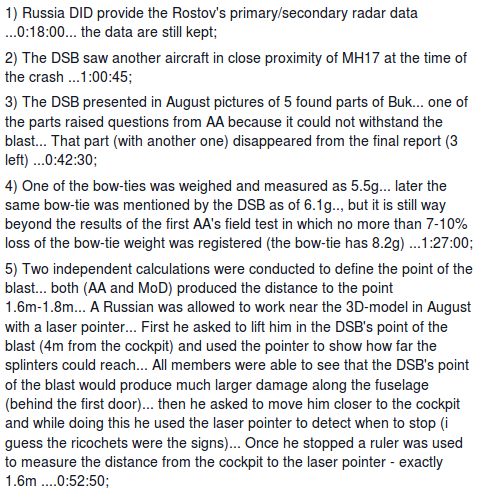
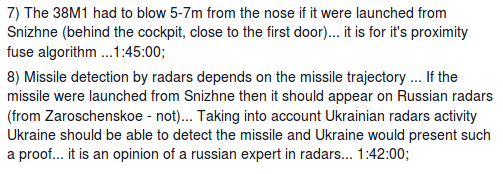
More info
http://news.rin.ru/eng/news///133811/
http://sputniknews.com/world/20151014/1028498849/Russia-MH17-Dutch-Report.html
http://bigstory.ap.org/article/e088dbecedff4cc9a95ecab641933599/russia-appeals-un-aviation-body-open-new-mh17-probe#

Oleg Storchevoy, deputy head of Russia’s national aviation regulator Rosaviatsia , held a press briefing on Wednesday, October 14, in Moscow. He said that Moscow categorically disagrees with the Dutch Safety Board’s report on last year’s crash of Malaysia Airlines flight MH17 in East Ukraine.
The pressconference can be seen here:
On a personal note I believe this is another attempt to confuse and mislead. One of the reasons is that Rosaviatsia seemed not to have read the DSB final report. One of the Russian journalists asked how many attachments the DSB report had. The response of Storchevoy was: “I cannot answer how may attachments the report has, we haven’t reviewed it in detail. So I will not answer” and “We didn’t have to read it (the final report) in detail, we only got it yesterday”.
“We do not refute or deny any versions. We believe that there is a need to conduct further studies to determine what the aircraft was struck by,” Storchevoy said according to Sputnik news.
“Russia will use the standard presented in annex 5.13 to the Convention on International Civil Aviation to initiate the resumption of the disaster investigation,” Oleg Storchevoy told reporters.
Alec Luhn, reporter in Moscow for The Guardian attended the meeting. Also Nataliya Vasilyeva of Associated Press attended the meeting. Below some of their Tweets. Also Tweets of Christo Grozev are included.
Some of the statements made by Rosaviatsia were :
- Russian official claims Dutch told investigators #MH17 Buk had launched from “Schnitze,” they misheard as “Snizhne”
- Storchevoi denies that Russia calculated #MH17 launch site near Snizhne, as Dutch report says
- #MH17 only gets more confusing. Almaz-Antey said yesterday it tested launch from Snizhne, Storchevoi says it tested launch from Zaroshchenke
- Storchevoi complains again that “Russian experts” were not allowed to go to the crash site in eastern Ukraine
- Storchevoi also contradicts Almaz-Antei saying MH17 was shot down by an older Buk, says they have not evidence to prove it was a Buk at all. “If it wasn’t the missile the Dutch say, what kind was it?” Russian official: “We’re continuing investigation”
- Russian aviation chief Storchevoi (again) blames the Netherlands to not bothering to remove wreckage from Hrabove until November. Storchevoi: well, the OSCE were hanging around there all the time, why couldn’t Dutch investigators come along?
- Spanish news agency: “Is it your official position that the Dutch contaminated evidence?”
RossAviation: Absolutely yes. We have proof. - “Not a single proof of bow-shaped schrapnel”
- RossAviation: “There is not a *single* hole in the plane’s remains that shows a bow-tie pattern”
- RossAviation: “The report includes a list of Russian inputs we gave in July. None of them were accepted, which we find unacceptable”
- RossAviation: “The NL report is weak on facts, quality is not up to our standards”
- RossAviation: Only if BUK came from Snizhne, our radars would have caught it. But not from Zaroshtenske. Maybe the Ukrainians caught it.
- RossAviation: “We saw a photo of a weighed bow-tie fragment early in the investigation. It showed 5.5 g. Now it shows 6.1 g. Manipulated”
- RossAviation: “Almaz Antey did not prove it was a BUK missile. They just calculated how it could have happened if it WAS a BUK”
More info
http://news.rin.ru/eng/news///133811/
http://sputniknews.com/world/20151014/1028498849/Russia-MH17-Dutch-Report.html
http://bigstory.ap.org/article/e088dbecedff4cc9a95ecab641933599/russia-appeals-un-aviation-body-open-new-mh17-probe#
28 Comments on Rosaviatsia Russia’s Federal Air Transport Agency states DSB manipulated investigation
13 Comments on A lot of evidence is missing or was not obtained on MH17
- An imaginary principal component analysis without data will be performed on the domain of the investigation of MH17.
First we notice the investigation got a wrong start since one of the accused (Russia) has been condemned before any research and legal judgment.
If the Western block was really convinced Russia was the perpetrator of the shooting of MH17, then just Russia would be treated with all egards and respect. Also separatists would not be put down as low intelligent drunks who accidentally captured a solitary BUK-TELAR.
It is legally use not to see suspects as criminals before they are convicted. This is also meant to get their cooperation to the investigation.
http://fortruss.blogspot.co.uk/2015/08/mh-17-investigation-is-injustice-to-all.html
[- We are facing a legal farce and a grave injustice for all the relatives of the 298 victims thanks to the fact that Netherlands and Ukraine have forgotten in the case of MH17 that “Nemo iudex in causa sua” or that no one should judge or investigate in his own cause, says Finnish judge and diplomat Peter Iiskola, who is expert in international air and space law.]
If the Western block wanted to frustrate the investigation by insulting one of the possible suspects (Russia), who became a random liar, naming and shaming proved an excellent way to thwart the whole investigation.
Our objective conclusion must be the Western block wanted to frustrate and thwart the investigation of MH17, what sabotage was not needed if they were convinced Russians or separatists were the perpetrators.
And a symbolic principal component analysis on the weird behavior of Western parties intuitively shows the Western alliance must be the perpetrator, since they behaved as subjects who try to hide a crime. Not that this would be the right conclusion but it would explain the deceitful behavior of the Dutch government and the illogical behavior of Ukraine, to say nothing about the USA.
So, the principal component (main factor) of our hypothetical factor analysis will be DISTRUST, intentionally caused by the Western block. Now you can forget the rest of your research. It is mud throwing and street fighting, as has happened. These are all objective facts.
All this happened because of the Chicago rules, which give alleged suspects (Ukraine) a decisive role in their own case. Of course the investigation must be conducted by independent scientists from independent institutes without ties with the countries involved.
The total variance of the investigation into MH17 can be explained by about 4 general factors:
1: DISTRUST FACTOR
2: OBSTRUCTION FACTOR
3: DECEIT FACTOR
4: SLOWING DOWN FACTOR
As main factor we see:
1: DISTRUST by political manipulation of the Western block of the investigation in accordance to Chicago rules. On this factor are loading two enormous bundles of vectors which set the Eastern against the Western front. This first factor will explain about 60 % of all variance in the investigation.
====
2: THE TECHNICAL OBSTRUCTION FACTOR
Partly nested within this factor is the TECHNICAL OBSTRUCTION FACTOR. It shows the antagonistic obstruction between the Western block and the separatist / Russian block. Within DISTRUST it explains most variance, since it hides the key to the perpetrator.
THE TECHNICAL OBSTRUCTION FACTOR is part of DISTRUST but also uniguely explains 20 % remaining variance as WITHHOLDING TECHNICAL INFORMATION. Again it puts our two blocks against each other, but partly under a different angle:
TECHNICAL OBSTRUCTION OF THE WESTERN BLOCK:
United States;
– There are no United States Air Force SBIRS satellite images available. Reason: classified.
– There are no United States Air Force optical satellite photos available. Reason: not known.
– There are no other military radar recordings available obtained during excersize Sea Breeze.
– There are no commercial satellite photos available of the BUK and the launchspot. Reason: unknown.
Ukraine:
– There are no primary radar recordings provided by the Ukraine Air Force. Reason: radar was switched off as the Air Force did not have flights planned for July 17.
– There are no primary radar recordings provided by the Ukraine civil air traffic control. Reason: radar was in maintenance.
TECHNICAL OBSTRUCTION OF THE EASTERN BLOCK:
Russia:
– There are no primary radar recordings provided by Russia. Reason: not kept after 30 days.
– There are no secondary radar recordings provided by Russia. Reason: not kept after 30 days.
====
3: DECEIT FACTOR (Sand in the Wheels)
Within the Western side of DISTRUST we find the bulk of a kind of stand-alone factor of which the counter side also lies in DISTRUST but not in the eastern block. It partly also has its own unique variance. Hence, within and outside DISTRUST, the factor has a somewhat different and unique angle:
THE DUTCH DECEIT FACTOR puts the pathological lying Dutch government against a honest faction of the parliament and a number of alert weblogs, whose WHATHAPPENEDTOFLIGHTMH17, De Nieuwe Realist, Arnold Greidanus, Erik Toonen and GeenStijl are most important:
3: DECEIT FACTOR (Sand in the Wheels):
A long list of obstruction:
— 1: It took a couple of days BEFORE THE DUTCH APPEARED at the crash site. Safety concerns were the main reason. The Dutch and Australian government considered deploying army forces to the crash site but this never happened.
–2: The Malaysian government was able to obtain the black boxes because they negotiated directly with the separatists. The Dutch seemed TO BE NOT INTERESTED in obtaining the black boxes. See more here.
(–)
(–)
–49: at January 12 2016 Member of Parliament Pieter Omtzigt requested to ask oral questions to the Dutch government on the missing radar recordings of both Ukraine and Russia. However the request was not granted by the chairwomen of the dutch parliament. (source: Tweet of Pieter Omtzigt). Omtzigt will now request a debate about the radar recordings.
–50: VVD and PvdA disagree to have a debat on the missing radar recordings. (Tweet Omtzigt)
–51: Pieter Omtzigt and various other members of parliament asked minister van der Steur 42 questions on Mr Maat. Prime minister Rutte promised to have these questions at the latest at January 12. However van der Steur sents a letter to the Parliament dated January 12 that he will not be able to answer the questions on Tuesday and will take the regular time for answering questions. (Tweet Omtzigt)
===
4: THE SLOWING DOWN FACTOR (DELAY OF INVESTIGATION)
Within the Western side of DISTRUST we also find the DSB FACTOR with its partly unique angle, which sets the Western against the Eastern front with pure neglect and looking away:
4: THE SLOWING DOWN FACTOR: (the looking away and neglect factor)
– The air traffic controller responsible for MH17 was not interviewed by the DSB.
– Eyewitness on the ground were not interviewed by DSB.
– Some parts of the cockpit roof with shrapnel damage were not used in the reconstruction. Found too late.
– Some parts of the business class section roof are missing. Reason: DSB did not immediately went to the crash site.
A very long list follows…
====
So the domain of disaster of MH17 definitely has been ruined by the Western world:
1: DISTRUST FACTOR (WESTERN WORLD)
2: OBSTRUCTION FACTOR (WESTERN AND EASTERN SIDE)
3: DECEIT FACTOR (NETHERLANDS)
4: SLOWING DOWN FACTOR (DSB)
Research into the assault on the MH17 has been an immoral act and an indictment against civilization. Antidyatel // January 13, 2016 at 1:52 pm //
There is one more critical piece of evidence that DSB was not interested about for some reason. Ukraine has less than 1000 Buk missiles in stock. Each of them had unique serial number. It would take maximum a week to go and catalogue the current location of those missiles just after the shoot down. Even now it might be useful. The good thing is that DSB could also request the lost from Russia who produced all those missiles. The request could be done simultaneously and delivered in sealed envelopes until both lists are available. That way there will be no chance of manipulation of evidence. It would be amazingly easy, reliable and cost effective solution. But it is amazing thatit was not even consideredLiane Theuer // January 13, 2016 at 4:07 pm //
Antidyatel, you know what the DSB would answer :
“We DEFINITELY know that it was a 9N314M warhead. And the Ukraine does not have this typ of warhead. So, why ask for a catalogue of ukrainian missiles ?”
TWO bow-ties of unknown origin support this statement…
But my counterquestion would be :
„Did you have prove for the type of weapon that early to obviate the need for asking the Ukraine to their buks ?“
- The DSB final report itself makes it difficult for the reader to follow the reasonings.
You have to struggle through the various Appendixes to find out what the DSB overall says to a certain thing.
An example: The evidence for the murder weapon.
Only after one has read the report and Appendixes, it becomes clear that the only evidence of “9N314M warhead, carried by a missile 9M38 series”, are the two bow-ties.
All the other “evidence” has NOT proved this specific type of weapon !
About the bow-tie, which was found in the cockpit, the DSB does not tell when it was found and by whom.
About the bow-tie, which was found in the body of the pilot, the DSB does not tell, who has taken the shrapnel out of the body.
Because, strangely enough, just the pilot’s body has not undergone detailed autopsy :
„Following identification, it was found that the body of the Captain from Team A was not one of the four bodies that underwent detailed examination.“
WHY NOT ???
„The body of the Captain from Team A had undergone an external and internal examination to remove foreign objects.“
WHERE WAS THAT DONE ? In the Netherlands or in Ukraine ???
WHY the body of Captain from Team A was burned ?
WHY in the whole report the chemical composition of this bow-tie is not specifically determined ?
In my eyes, the final report raises more questions than it answers.
And my question-list is very long ! - IMPORTANT :
The Russian aviation authority Rosaviacia has named six new facts that demonstrate the lack of credibility of the conclusions drawn by the Netherlands, according to which the MH17 had been shot with a 9M38M1-Buk missile.
These details are contained in an official letter of the Vice Chief of the Authority, Oleg Stortschewoj, to the chairman of the Dutch Security Tjibbe Joustra.
Here is the link (scroll down to read the english version. Open the 12 pages appendix in english !)
http://www.favt.ru/novosti-novosti/?id=2311
As I wrote in my previous post about captains body, the appendix contains a new information.
Because the DSB doesn´t mention who the four bodies were, that undervent a special examination :
2.1. Fragments
Section 2.16 (Fig. 37, Table 11) of the Factual Information part of the final report indicates that a total of two bow-tie shaped fragments consistent with the 9N314M warhead were found:
• Fragment 1: 14 × 14 × 4.5 millimeters, 6.1 grams, found in the cockpit;
• Fragment 2: 12 × 12 × 5 millimeters, 5.7 grams, found in the captain’s body.
Yet Section 2.12 of Annex X mentions only one fragment (14 × 14 × 4.5 mm) found in the cockpit (Fragment 1).
The data provided in the final report is inaccurate, because the actual mass of Fragment 1 is 5.5 grams, not 6.1 grams, as evidenced by the photos made by members of the international investigation team during the weighing of this fragment in February 2015 at the Gilze-Rijen air base. In addition, the final report does not specify where exactly the fragment was found in the cockpit.
The captain’s body from which Fragment 2 was extracted did not undergo special examination (instead, the body of the Team B captain, who was not present in the cockpit at the time of the accident, was examined).Eugene // January 14, 2016 at 9:28 pm //
The letter is probably one formal step in a planned course of actions by Rosaviacia. It makes the complaints official, unlike their informal October presentation.
One seemingly innocent point is very interesting. Rosaviacia claims that the DSB report stated a wrong weight of one of the bowties, and that they have a proof of that – the photographs of the scales when the piece was weighed. For the DSB it would be very easy to respond to this allegation – just let Rosaviacia representatives reweigh the piece. This would also be an easy way to discredit the rest of Rosaviacia’s claims.
But if the DSB do not let Russians reweigh the bit, then this will be a final proof that the DSB are lying bastards.
So, if the weight is indeed wrong, it seems that the best action for the DSB, is either to ignore the Russian allegations, which would also serve as a good indication that they’ve lied in the report, or to tell that there has been a mistake in the stated weight.
If the DSB admit that they’ve stated a wrong weight by mistake they’ll still be in trouble. Few people will believe them because a typo in the weight of such a critical piece of evidence is pretty much impossible. Besides, this will cast big doubts on the overall integrity of the report.
My bet is that the DSB will make it look like they haven’t noticed the Rosaviacia letter and will do nothing about it.- OLEG STORCHEVOY (ROSAVIATSIYA)
http://www.favt.ru/novosti-novosti/?id=2311 (press below: English)
In defense of Ukraine not to have warned civil aviation for the risks of flying over Donetsk has been given the argument that from a proud state cannot be expected to admit to have lost control of its country. But also Chicago rules are involved in this situation:
[Also, the final report unfairly obscures the issue of liability, shifting the blame from Ukraine to airlines and international aviation organizations, e.g., ICAO. The final report basically ignores the clarification provided by ICAO in Letter AN13/4.2-14/59 on July 24, 2014, which clearly stresses in paragraph 6 that “the obligations of States under the Convention and the requirements in its annexes should not be confused with hazard notifications circulated in State letters by ICAO under those exceptional circumstances where potential risks to the safety of civil aviation operations are incapable of being effectively communicated by States, whether over sovereign territory or over the high seas.”]
About 9N314M:
[The new important fact is that, even assuming the aircraft was brought down by a Buk surface-to-air missile, the description of fragments provided in the report [and found in the cockpit] does not match the pre-formed [bowtie] fragments used in the 9N314M warhead.]
Butterfly or bow-tie shrapnel found in the bodies of the captain, the purser and the first officer in the cockpit:
http://tinyurl.com/hcvjg6g
[Russian experts examined the chemical composition of the material used to manufacture pre-formed fragments of the 9N314M warhead and concluded that the chemical composition of the retrieved fragments as published in the final report does not agree with the conclusion that they belonged to a 9N314M warhead.]
Additional statement:
In addition to proven shortcomings of fragments allegedly coming from a 9N314M-warhead, and causing the crash of MH17, no proof or indication is given that these fragments fulfill the conditional probability of penetration through the hull or the windshields. In case of doubt the number of bowties which must have entered the aircraft can be accurate estimated.
[The final report and its appendices fail to provide any information on the shape of penetration holes,(–)]
[Section 2.12 of the Factual Information part and Section 3.5 of the Analysis part in the final report, as well as Section 2.13 of Appendix X, indicate the approximate number of penetration holes in the skin of the left-hand side of the cockpit (around 200) and the perpendicular dimensions of 31 penetration holes. No further examination of penetration holes on the aircraft wreckage was performed.]
DSB is a political institute. A scientific institute would provide the world with raw data of impacts on MH17. Then theories about bowties could be confirmed or falsified.
[Forensic examination of paint is normally based on the chemical analysis of paint samples. Often, the objective is to establish whether certain pigments are present in the paint. However, due to the fact that the same chemical elements may be present in paints manufactured by different companies, the results of paint analysis can only be considered as indirect evidence corroborating other types of evidence.]
This also applies to traces of aluminum and zirconium allegedly found on bowties in the cockpit, which possibly will be used in all kinds of Boeing.
Hence, JIT should cite irrefutable physical evidence of the bow-ties just related to this very plane. Since aluminum and zirconium on the bow-ties also can be obtained by shooting a warhead against an identical Boeing, after which the bowtie could have been brought into the body of the captain of team A. Not that this is very likely but DSB – as a research institute – has taken a gigantic risk by possibly backing the wrong horse. JIT certainly better comes with newly found butterflies on the wreckage.
If the following is true, this might be devastating information, since the cockpit would not have been ruined. Here we miss a counter-investigation into the algorithm and the technical specifications of the proximity fuse:
[According to the data provided by the company that designed the Buk surface-to-air missile system, if a 9M38-series missile approaches an aircraft at the angle presented in the final report, the algorithm of its proximity fuse will detonate the warhead after a certain delay so that the detonation area is 3-5 meters away from the nose towards the tail, which does not agree with the actual data.] The English translation of the letter and attachment is online at http://www.favt.ru/public/materials//1/6/c/0/3/16c0341512fcae3c1ebd64fd2a486136.rtf.
'The engagement conditions (the detonation area and orientation of the missile in relation to the aircraft) indicated in the final report contradict the technical specifications of the proximity fuse used in Buk missiles. Under these [DSB]conditions, the warhead detonation point could not be closer to the nose tip of the aircraft than 3 to 5 meters.'DSB/TNO report appendix Y, page 7:http://tinyurl.com/pyrhmr2
This means the missile might have come from Zaroshchenske:
http://tinyurl.com/hg39pfx
And from Zaroshchenske the right engine might be targeted by the radar of BUK-TELAR in the first place:
http://tinyurl.com/hnkw4c9
From Zaroshchenske it would be a 9M38-series missile with a 9N314 warhead.
The rest of the report shows the tunnel vision of the Dutch who first determined 9N314M as the warhead used and then selected the best model to match the holes in the hull as if 9N314M was true. This is pure circular reasoning. As a matter of fact they had to leave roof plates and other elements out or their research to sustain the 9N314M model.
http://tinyurl.com/z2zd2e2- http://www.favt.ru/novosti-novosti/?id=2311
http://tinyurl.com/hcvjg6g
In Russian experiments with the 9N314M warhead, the average mass of bow-tie fragments that preserved their shape after penetrating several aluminum sheets (with a combined thickness of 12 mm) in one case and the cockpit of an Ilyushin Il-86 aircraft in the other case was 7.2-7.9 grams. The average loss of mass was merely 3-12 percent.
Remark:
Russian analysis on bowties must be split into aluminum sheets and the cockpit. Aggregate figures are not acceptable. The proper analysis must be equivalent with a single perforation on the aluminum skin of Boeing 777 of 23 mm with special aluminum. Boeing 777 uses ALCOA Triple X ALUMINUM skin.
Full description of the experiment is required in number of sample elements, means and standard deviations, to determine if alleged bowties found in MH17 differ significantly from these results.
http://courses.washington.edu/ie337/Boeing%20Tour%20Facts.pdf
Fuselage skin Boeing 777 average thickness .08 -.09 inches or 0.2-0.23 cm.
The Russian results:
2.1. Fragments
Section 2.16 (Fig. 37, Table 11) of the Factual Information part of the final report indicates that a total of two bow-tie shaped fragments consistent with the 9N314M warhead were found:
• Fragment 1: 14 × 14 × 4.5 millimeters, 6.1 grams, found in the cockpit;
• Fragment 2: 12 × 12 × 5 millimeters, 5.7 grams, found in the captain’s body.
Yet Section 2.12 of Annex X mentions only one fragment (14 × 14 × 4.5 mm) found in the cockpit (Fragment 1).
The data provided in the final report is inaccurate, because the actual mass of Fragment 1 is 5.5 grams, not 6.1 grams, as evidenced by the photos made by members of the international investigation team during the weighing of this fragment in February 2015 at the Gilze-Rijen air base. In addition, the final report does not specify where exactly the fragment was found in the cockpit.
The captain’s body from which Fragment 2 was extracted did not undergo special examination (instead, the body of the Team B captain, who was not present in the cockpit at the time of the accident, was examined).
The new important fact is that, even assuming the aircraft was brought down by a Buk surface-to-air missile, the description of fragments provided in the report does not match the pre-formed fragments used in the 9N314M warhead.
The final report does not take into account the mass of the bow-tie shaped fragments. Compared with standard bow-tie shaped fragments used in the 9N314M warhead, which weigh 8.1 grams and are 8.2 millimeters thick:
• Fragment 1 in reality lost 32 percent of its mass (or, based on the mass indicated in the report, 24.7 percent);
• Fragment 2 lost 29.6 percent of its mass;
• Relative transverse deformation (thickness reduction) of the fragments was over 60 percent.
The significant loss of mass in Fragment 1 cannot be explained by damage because the fragment does not appear greatly damaged (otherwise, it would lose its bow-tie shape).
Fragment 2 shows clear signs of damage, specifically in the transversal section (in relation to the front side). The diminished mass of this fragment can be explained by damage. However, the thickness of the fragment indicates significant deformation (over 60 percent), which is not consistent with its shape.
Russian experts have examined the effects of obstacle penetration on the shape and mass of bow-tie fragments of the 9N314M warhead by staging full-scale experiments and simulating transversal deformation of fragments.
In experiments with the 9N314M warhead, the average mass of bow-tie fragments that preserved their shape after penetrating several aluminum sheets (with a combined thickness of 12 mm) in one case and the cockpit of an Ilyushin Il-86 aircraft in the other case was 7.2-7.9 grams. The average loss of mass was merely 3-12 percent.
[Remark: This must be done with the resistance of a full layer aluminum at once. Also it is unacceptable to combine results of research.]
The simulation of transversal deformation revealed that the shape of a fragment with 60 percent transverse deformation is very different from the shape of the fragments presented in Section 2.16 (Fig. 37, Table 11) of the Factual Information part of the final report.
The results of these experiments and simulations are consistent with the results of validation tests of the 9N314M warhead, in which 96 percent of bow-tie fragments preserved their shape and lost only 6-7 percent of their mass after penetrating two 5-mm sheets of steel.
[Remark: No technical and statistical information delivered.]
Thus, the mass and dimensions of the two fragments (Section 2.16, Fig. 37, Table 11 of the Factual Information part of the final report), based on which the report concludes that the aircraft was hit by a 9N314M warhead, are not consistent with the results of the full-scale experiments and simulations.
[Concluding: Only research on full thickness of aluminum (2.3 cm) in a single perforation can be used. Aggregate figures from different kinds of research are not acceptable. All research parameters must be given, especially the number of sample elements, means and standard deviations, to see if alleged bowties from MH17 differ significantly. Test must be controlled by independent research institutes.]- “the aluminum skin of Boeing 777 of 23 mm with special aluminum.”
Is it a typo? Should be 2.3mm, correct?
Thanks, that’s correct 
- http://www.favt.ru/novosti-novosti/?id=2311
http://tinyurl.com/hcvjg6g
Russians must prove alleged bowties from MH17 came from regular or irregular (rusty) bowtie populations. The hypothesis is bowties are rusting away – and are losing weight – as a function of time, which is an independent variable. This means also rusty bowties (made from unalloyed steel) must be collected left behind after field tests with 9N314M.
Recovered rusty bowties are weighted before and after cleaning in a rust remover and an alcohol solution. Now a number of subpopulations with different weight arises from which the alleged bowties in MH17 might not diverge significantly.
SECOND HAND BOWTIES
http://www.favt.ru/novosti-novosti/?id=2311
http://tinyurl.com/hcvjg6g
Rosaviatsia letter January 2016:
[The final report does not take into account the mass of the bow-tie shaped fragments. Compared with standard bow-tie shaped fragments used in the 9N314M warhead, which weigh 8.1 grams and are 8.2 millimeters thick:
• Fragment 1 in reality lost 32 percent of its mass (or, based on the mass indicated in the report, 24.7 percent);
• Fragment 2 lost 29.6 percent of its mass;
• Relative transverse deformation (thickness reduction) of the fragments was over 60 percent.]
Rosaviatsia only concludes about bowties, why not about squares (cubes)? Are they from different populations (warheads)?
In the link above, especially bowties give a rusty impression; it is as if they have been cleaned somehow. Now we already know shrapnel might corrode in the warhead, but the square (cube) definitely did not. This means those elements likely came from different populations. They apparently did not emerge from the same warhead.
Repetition from October 2015:
Weird differences in weight of bowties and possible deception in this regard by DSB force us to re examine the origin of the bowties. And look, we fall into repetition because this debate has been conducted earlier. And indeed it was the same subject:
http://www.whathappenedtoflightmh17.com/rosaviatsia-russias-federal-air-transport-agency-states-dsb-manipulated-investigation/#comment-10535
October 2015 we noticed it was difficult to distinguish rusty from not-rusty shrapnel, not realizing “rusty” might be the clue to dismantle possible lies:
[The origin and the elemental composition of the 72 selected fragments were determined only qualitatively. It was found 43 of the 72 examined fragments consisted of unalloyed steel (rusty = warhead); hence, 29 were not from a warhead (stainless steel and one otherwise). That ‘otherwise’ fragment was non-metallic (coal-slag).]
And we have elucidated the hide and seek text in the DSB report as follows:
[Hence on 14 rusty, out of 20 rusty, out of 43 rusty, out of 72 selected objects THEY FOUND ZIRCONIUM. BUT… POSSIBLY NOT ON THE BOWTIES.
‘The chemical composition of 20 selected fragments which had either a very distinctive shape (including the two bow-tie shaped pre-formed fragments) or a layer of deposits OR BOTH was determined. This was determined by means of laser-ablation inductively coupled plasma mass spectrometry.’]
Wouldn’t we be interested in found deposits just on the bow ties? DSB, you were expected just to say: We found aluminum and/or zirconium on the bowties. From the English text we might conclude you did. But you played hide and seek and forced us to parse the text to come to a conclusion.
But from the (not leading) Dutch text we conclude no aluminum and/or zirconium was found on the bowties:
[‘Van 20 geselecteerde fragmenten met OFWEL een zeer uitgesproken vorm (waaronder de twee fragmenten in de vorm van een vlinderdas) OFWEL [[EN/OF; BD]] een laagje afzettingen werd de chemische samenstelling vastgesteld.’
Is it ‘and’, is it ‘or’ or is it ‘and/or’?
Hence, we don’t know if the bowtie had a layer of deposits. If not, we don’t know how it came into the body of the captain. May be no zirconium was found on the two bowties. Maybe they did not come through the window but through the skin of the cockpit. Maybe they were shot into the body of the captain of team A by criminals. We have no information from this research.]
[Now earlier was said 15 high energy objects were found in the crew of the cockpit. We also know 14 of the 20 had zirconium. So 6 out of 15 high energy objects, found in the crew possibly had no zirconium. One of them might be the bowtie found in the captain’s body.
So it turned out zirconium was found in 14 out of 72 pieces of possible warhead shrapnel. Hence and to be fair, if zirconium has been found on the bowtie in the body of the captain, it might be an important clue. But this zirconium has been demonstrated only qualitatively and it has not been cross checked by independent institutes. Hence this will not be enough to convince the judges. At most there could be a correlation between 9N314M and MH17; causality is not proven.]
In another way, we also wondered if aluminum and/or zirconium were found on the alleged bowtie in the body of the captain of team A. But despite parsing of the text we were not convinced by our own conclusion:
http://www.whathappenedtoflightmh17.com/rosaviatsia-russias-federal-air-transport-agency-states-dsb-manipulated-investigation/#comment-10739
Here I possibly drew the wrong conclusion bowties were covered with aluminum and zirconium, but a scientific report must not be written as a detective roman:
[http://cdn.onderzoeksraad.nl/documents/report-mh17-abouttheinvestigation-en.pdf
3.3 Analysis and assessment
2. What hit the aero plane of flight MH17 (and what did not) (page 35)
It looks like DSB in the results mingles:
1: fragments of shrapnel (splinters).
2: bowties and cubes.
3: fragments or parts of a missile.
Fragments of shrapnel:
Part 1:
‘Metal fragments
The shape and size of the metal fragments made it possible to issue statements about their source. A NUMBER of these fragments had a special shape, which can basically be described as CUBIC AND BOW-TIE SHAPED. Knowledge of weapons was used to establish that fragments having THIS SHAPE are released at the detonation of a certain type of warhead. Using knowledge about different types of weapons, a corresponding weapon was sought that could contain fragments WITH THIS TYPE OF SHAPE. Traces (of aluminum and glass) THAT WERE DISCOVERED ON THE FRAGMENTS were also relevant, because this enabled the investigators to deduce whether, and with what, the fragments had collided’.
Here ‘THE’ definitely refers to a certain group of fragments extracted from the whole: bowties and cubes. Hence they have proof the bowties came through the cockpit window and/or the outer skin of the plane.]
(But in the rebound of January 2016 I think I drew the wrong conclusion in October 2015 and DSB arbitrarily concatenated this sentence to the foregoing: ‘Traces (of aluminum and glass) THAT WERE DISCOVERED ON THE FRAGMENTS were also relevant, because this enabled the investigators to deduce whether, and with what, the fragments had collided’. So, from this text we cannot conclude the bowtie allegedly found in the body of the captain of team A was covered with aluminum and zirconium)
Proceeding:
[But what comes now: fragments of shrapnel or fragments of a missile?
Connecting Part II:
‘The Dutch Safety Board attempted to obtain reference material of the suspected weapon in order to further substantiate the origin of THE fragments. The objective was to establish that the chemical composition of THE fragments was consistent with that of the suspected weapon. This was not achieved, so this verification could not take place’
Does this mean bowties chemically did not match 9H314M? Or missile fragments did not match 9H314M or the missile? No, it definitely has been concluded bowties were not of the same chemical composition as a warhead. But that’s not important. Only important is if the two bowties are covered with aluminum and zirconium from MH17. And that’s they confirmed.]
(No, in January 2016 I doubt this conclusion).
[Connecting Part III:
‘During the recovery of the aero plane, OTHER OBJECTS were found that correspond with parts of a specific missile in terms of shape and appearance. Two shards were discovered in the aero plane (in the cockpit and the left wing tip). The paint and traces on the shards and traces on pieces of the wreckage were compared with paint and traces of an explosive on THE OBJECTS that were found. These analyses were performed by the Netherlands Forensic Institute (NFI) at the request of the Public Prosecution Service and shared with the Dutch Safety Board.’
Now we are sure OTHER OBJECTS are part of the missile and metal fragments (shrapnel, inclusive bowties and cubes) chemically were NOT involved in a warhead or a missile. We also know aluminum and zirconium of MH17 were found on the bowties and cubes. Maybe JIT has some proof which it does not want to reveal to the public now. Maybe they also have proof of butterfly images on the fuselage…
What we see is JIT keeps its powder dry because, since as has been argued previously in this place they have no legal position. Would they now already lay their cards on the table suspects would take a stand to crumble their arguments.]
(No, this is a wrong end conclusion, since the text is completely distracting and misleading.)
http://www.favt.ru/novosti-novosti/?id=2311
http://tinyurl.com/hcvjg6g
Rosaviatsia letter January 2016:
[The final report does not take into account the mass of the bow-tie shaped fragments. Compared with standard bow-tie shaped fragments used in the 9N314M warhead, which weigh 8.1 grams and are 8.2 millimeters thick:
• Fragment 1 in reality lost 32 percent of its mass (or, based on the mass indicated in the report, 24.7 percent);
• Fragment 2 lost 29.6 percent of its mass;
• Relative transverse deformation (thickness reduction) of the fragments was over 60 percent.]
Rosaviatsia only concludes about bowties, why not about squares (cubes)? Are they from different populations (warheads)?
In the link above, especially bowties give a rusty impression; it is as if they have been cleaned somehow. Now we already know shrapnel might corrode in the warhead, but the square (cube) definitely did not. This means those elements likely came from different populations. They apparently did not emerge from the same warhead.
Repetition from October 2015:
Weird differences in weight of bowties and possible deception in this regard by DSB force us to re examine the origin of the bowties. And look, we fall into repetition because this debate has been conducted earlier. And indeed it was the same subject:
http://www.whathappenedtoflightmh17.com/rosaviatsia-russias-federal-air-transport-agency-states-dsb-manipulated-investigation/#comment-10535
October 2015 we noticed it was difficult to distinguish rusty from not-rusty shrapnel, not realizing “rusty” might be the clue to dismantle possible lies:
[The origin and the elemental composition of the 72 selected fragments were determined only qualitatively. It was found 43 of the 72 examined fragments consisted of unalloyed steel (rusty = warhead); hence, 29 were not from a warhead (stainless steel and one otherwise). That ‘otherwise’ fragment was non-metallic (coal-slag).]
And we have elucidated the hide and seek text in the DSB report as follows:
[Hence on 14 rusty, out of 20 rusty, out of 43 rusty, out of 72 selected objects THEY FOUND ZIRCONIUM. BUT… POSSIBLY NOT ON THE BOWTIES.
‘The chemical composition of 20 selected fragments which had either a very distinctive shape (including the two bow-tie shaped pre-formed fragments) or a layer of deposits OR BOTH was determined. This was determined by means of laser-ablation inductively coupled plasma mass spectrometry.’]
Wouldn’t we be interested in found deposits just on the bow ties? DSB, you were expected just to say: We found aluminum and/or zirconium on the bowties. From the English text we might conclude you did. But you played hide and seek and forced us to parse the text to come to a conclusion.
But from the (not leading) Dutch text we conclude no aluminum and/or zirconium was found on the bowties:
[‘Van 20 geselecteerde fragmenten met OFWEL een zeer uitgesproken vorm (waaronder de twee fragmenten in de vorm van een vlinderdas) OFWEL [[EN/OF; BD]] een laagje afzettingen werd de chemische samenstelling vastgesteld.’
Is it ‘and’, is it ‘or’ or is it ‘and/or’?
Hence, we don’t know if the bowtie had a layer of deposits. If not, we don’t know how it came into the body of the captain. May be no zirconium was found on the two bowties. Maybe they did not come through the window but through the skin of the cockpit. Maybe they were shot into the body of the captain of team A by criminals. We have no information from this research.]
[Now earlier was said 15 high energy objects were found in the crew of the cockpit. We also know 14 of the 20 had zirconium. So 6 out of 15 high energy objects, found in the crew possibly had no zirconium. One of them might be the bowtie found in the captain’s body.
So it turned out zirconium was found in 14 out of 72 pieces of possible warhead shrapnel. Hence and to be fair, if zirconium has been found on the bowtie in the body of the captain, it might be an important clue. But this zirconium has been demonstrated only qualitatively and it has not been cross checked by independent institutes. Hence this will not be enough to convince the judges. At most there could be a correlation between 9N314M and MH17; causality is not proven.]
In another way, we also wondered if aluminum and/or zirconium were found on the alleged bowtie in the body of the captain of team A. But despite parsing of the text we were not convinced by our own conclusion:
http://www.whathappenedtoflightmh17.com/rosaviatsia-russias-federal-air-transport-agency-states-dsb-manipulated-investigation/#comment-10739
Here I possibly drew the wrong conclusion bowties were covered with aluminum and zirconium, but a scientific report must not be written as a detective roman:
[http://cdn.onderzoeksraad.nl/documents/report-mh17-abouttheinvestigation-en.pdf
3.3 Analysis and assessment
2. What hit the aero plane of flight MH17 (and what did not) (page 35)
It looks like DSB in the results mingles:
1: fragments of shrapnel (splinters).
2: bowties and cubes.
3: fragments or parts of a missile.
Fragments of shrapnel:
Part 1:
‘Metal fragments
The shape and size of the metal fragments made it possible to issue statements about their source. A NUMBER of these fragments had a special shape, which can basically be described as CUBIC AND BOW-TIE SHAPED. Knowledge of weapons was used to establish that fragments having THIS SHAPE are released at the detonation of a certain type of warhead. Using knowledge about different types of weapons, a corresponding weapon was sought that could contain fragments WITH THIS TYPE OF SHAPE. Traces (of aluminum and glass) THAT WERE DISCOVERED ON THE FRAGMENTS were also relevant, because this enabled the investigators to deduce whether, and with what, the fragments had collided’.
Here ‘THE’ definitely refers to a certain group of fragments extracted from the whole: bowties and cubes. Hence they have proof the bowties came through the cockpit window and/or the outer skin of the plane.]
(But in the rebound of January 2016 I think I drew the wrong conclusion in October 2015 and DSB arbitrarily concatenated this sentence to the foregoing: ‘Traces (of aluminum and glass) THAT WERE DISCOVERED ON THE FRAGMENTS were also relevant, because this enabled the investigators to deduce whether, and with what, the fragments had collided’. So, from this text we cannot conclude the bowtie allegedly found in the body of the captain of team A was covered with aluminum and zirconium)
Proceeding:
[But what comes now: fragments of shrapnel or fragments of a missile?
Connecting Part II:
‘The Dutch Safety Board attempted to obtain reference material of the suspected weapon in order to further substantiate the origin of THE fragments. The objective was to establish that the chemical composition of THE fragments was consistent with that of the suspected weapon. This was not achieved, so this verification could not take place’
Does this mean bowties chemically did not match 9H314M? Or missile fragments did not match 9H314M or the missile? No, it definitely has been concluded bowties were not of the same chemical composition as a warhead. But that’s not important. Only important is if the two bowties are covered with aluminum and zirconium from MH17. And that’s they confirmed.]
(No, in January 2016 I doubt this conclusion).
[Connecting Part III:
‘During the recovery of the aero plane, OTHER OBJECTS were found that correspond with parts of a specific missile in terms of shape and appearance. Two shards were discovered in the aero plane (in the cockpit and the left wing tip). The paint and traces on the shards and traces on pieces of the wreckage were compared with paint and traces of an explosive on THE OBJECTS that were found. These analyses were performed by the Netherlands Forensic Institute (NFI) at the request of the Public Prosecution Service and shared with the Dutch Safety Board.’
Now we are sure OTHER OBJECTS are part of the missile and metal fragments (shrapnel, inclusive bowties and cubes) chemically were NOT involved in a warhead or a missile. We also know aluminum and zirconium of MH17 were found on the bowties and cubes. Maybe JIT has some proof which it does not want to reveal to the public now. Maybe they also have proof of butterfly images on the fuselage…
What we see is JIT keeps its powder dry because, since as has been argued previously in this place they have no legal position. Would they now already lay their cards on the table suspects would take a stand to crumble their arguments.]
(No, this is a wrong end conclusion, since the text is completely distracting and misleading.)
- „.. we cannot conclude the bowtie allegedly found in the body of the captain of team A was covered with aluminum and zirconium.“
Precisely. This applies to BOTH bow-ties !
To my knowledge, the DSB has not said anything to the special chemical composition of the bow-ties. Because they call bow-ties and cubes always together !
http://www.whathappenedtoflightmh17.com/a-lot-of-evidence-is-missing-or-was-not-obtained-on-mh17/
The English translation of the letter and attachment is online at
http://www.favt.ru/public/materials//1/6/c/0/3/16c0341512fcae3c1ebd64fd2a486136.rtf
Mr. T.H.J. Joustra
Chairman, Dutch Safety Board
PO Box 95404 25 09 CK The Hague
Dear Mr. Joustra,
In September 2015, the Federal Air Transport Agency sent you a letter pointing out a number of contradictions and discrepancies in the investigation into the crash of Boeing 777-200 9M-MRD (Flight МН17) near Hrabove, Ukraine, on July 17, 2014. We have not received any reply to the above letter. The final report released on October 13, 2015, did not reflect many of the important facts that the Russian side had repeatedly drawn your attention to.
The Russian experts who had participated in the investigation continued their research based on the additional data specified in the final report and as a result obtained some new important facts that had been not examined in the course of the investigation.
Based on the provision stipulated by standard 5.13 of Annex 13 to the Chicago Convention, I herewith forward for your consideration and decision-making new important facts that need to be reflected in the final report.
The new important facts obtained by the Russian experts through additional experiments and examinations attest to the fact that the information provided in the final report with regards to the following conclusions was unsubstantiated and inaccurate:
· on the possible presence of heavy air defense systems in eastern Ukraine that were not controlled by Ukrainian government forces;
· that the aircraft was hit by a 9N314M high-explosive fragmentation warhead;
· that the warhead that hit the aircraft was carried by a 9M38-series missile launched by a Buk surface-to-air missile system;
· on the position of the missile in relation to the aircraft at the moment of detonation, as well as the area it was launched from.
We emphasize that all the statements in this letter are limited strictly to the conclusions drawn by the investigation team regarding the circumstances of the aircraft downing and analysis of Ukraine’s failure to close its airspace. This letter does not touch upon the recommendations on the safety of civil aircraft presented in the final report, as the Russian side intends to comment on them separately.
Attachment on 12 pages.
Yours sincerely
Oleg Storchevoy
Deputy Director,
Federal Air Transport Agency of Russia
Accredited Representative of the Russian Federation to
International Investigation Team on MH17 Crash
Attachment
to the letter of the FATA
1. Grounds for closing Ukraine’s airspace prior to the crash of Boeing 777, Flight MH17
The final report reviews requirements contained in the Chicago Convention on International Civil Aviation and its annexes germane to the provision of flight safety over areas that may pose a threat to civil aircraft (Sections 4.2.1 and 4.2.2 of the final report).
The conclusion made in the report (Section 6.6.2 of the final report) that Ukraine, having sovereign control of its airspace, was responsible for ensuring the safety of flights, including situations where another state is the source of a threat, appears to be incomplete and does not reflect the objective fact that Ukraine ignored safety risks for civil aircraft after unleashing hostilities in the east of the country.
The final report names the accidents of an Antonov An-26 on July 14, 2015, and a Sukhoi Su-25 on July 16, 2015, as the only grounds based on which Ukraine should have fully closed its airspace, which is absolutely inadequate.
Standard 3.1.3 of Annex 17 to the Chicago Convention on International Civil Aviation, as well as ICAO Document 9554, require that states keep the level of threat to civil aviation within their territory under constant review.
Obviously, the Antonov An-26 and Sukhoi Su-25 accidents cannot be considered as the only grounds based on which the Ukrainian authorities should have made a decision to completely suspend civil flights over the conflict zone. The Ukrainian authorities should have made this decision back in April 2014, when hostilities broke out in eastern Ukraine after the Acting Ukrainian president signed Decree 405/2014 “On the Decision by Ukraine’s National Security and Defense Council of April 13, 2014, ‘On Urgent Measures to Counter the Terrorist Threat and Preserve the Territorial Integrity of Ukraine,’” after which confrontation between Ukraine’s official authorities and opposition forces in eastern Ukraine escalated, creating a conflict zone unsafe for civil flights. After the Ukrainian president issued Decree 405/2014, both military and aviation authorities of Ukraine should have begun implementing coordinated measures to ensure the safety of civil flights over the conflict zone, as recommended by Section 2.15 of ICAO Document 9554.
In addition, while issuing a restriction for the use of airspace below FL260, and then FL320, the Ukrainian authorities failed to develop and publish special procedures for the instances described in ICAO Document 9554, Section 3.9, Subsection E (the last bullet): coordination in the event of civil aircraft emergencies or other unforeseen circumstances. Nevertheless, the final report does not address the question of whether Ukraine prepared appropriate ground infrastructure considering the risks of simultaneous operations by civil and military aircraft over the conflict zone. The report fails to mention that the Dnipropetrovsk ATC Center primary radar outage and the fact that the Ukrainian Air Defense monitoring systems were not integrated as a backup option created additional risks for flights over the conflict zone in the event of further outages of ground-based equipment or other unforeseen circumstances.
Besides, the statements by US and NATO officials presented in the final report (Section 5.4) are limited to speculations on whether Russian troops or the Russian Army’s weapons were present in Ukraine, which is not true.
The final report does not provide any facts regarding the presence or the use of Buk surface-to-air missiles in the region, but references to the Antonov An-26 and Sukhoi Su-25 accidents do not rule out such a possibility. Consequently, the conclusion made in the final report that the Ukrainian authorities should have closed their airspace undeservedly narrows down the time when they should have made this decision to July 14-17, 2014, and links it with the alleged appearance of “heavy” air defense systems, not controlled by Ukrainian government forces, in the region.
Also, the final report unfairly obscures the issue of liability, shifting the blame from Ukraine to airlines and international aviation organizations, e.g., ICAO. The final report basically ignores the clarification provided by ICAO in Letter AN13/4.2-14/59 on July 24, 2014, which clearly stresses in paragraph 6 that “the obligations of States under the Convention and the requirements in its annexes should not be confused with hazard notifications circulated in State letters by ICAO under those exceptional circumstances where potential risks to the safety of civil aviation operations are incapable of being effectively communicated by States, whether over sovereign territory or over the high seas.”
Sections 7.6.1, 7.6.2 and 7.6.3 of the final report point out the lack of reaction from ICAO and other states and airlines in terms of introducing their own restrictions on flights over Ukraine. Again, the report mentions the Antonov An-26 crash as grounds for making such a decision. But this accident was only reported by the Ukrainian President’s Executive Office in a closed briefing for Western diplomats (Section 5.7) and contained obvious discrepancies. (Information provided by the Dutch Military Intelligence and Security Service (MIVD) in Section 5.2.2 of Appendix T of the final report also points out contradictions in official statements by the Ukrainian authorities.)
Throughout the whole period from the beginning of the armed conflict in April up to the MH17 crash in July 2014, the Ukrainian authorities failed to issue a single official NOTAM that would unambiguously, as required by international standards, indicate threats to the safety of international civil aircraft associated with the use of various weapon systems in the region as a consequence of the armed conflict.
The final report does not provide any facts indicating the deficiency of ICAO requirements or national documents of Ukraine which could explain Ukraine’s failure to make a timely decision to close its airspace over the conflict zone.
Thus, the Ukrainian authorities deliberately concealed or distorted information on real threats to the safety of civil flights arising from the military activities of Ukraine’s Ministry of Defense in abuse of Article 9 of the Chicago Convention on International Civil Aviation, Annexes 15 and 19, as well as ICAO Document 9554. As a result, other states and airlines (including Malaysia Airlines) did not have sufficient official information for making a decision to suspend flights over Ukraine.
2. Conclusion that the aircraft was hit by a 9N314M warhead
Section 10.2 of the final report indicates that:
• the aircraft was struck by a large number of small fragments made of unalloyed steel moving at high velocity, their shape and size consistent with the 9N314M warhead (subsections 5, 6 and 10);
• the location, size and boundaries of the damage, as well as the density of hits on the wreckage, are consistent with the 9N314M warhead (subsections 6 and 10).
Thus, the conclusion that the aircraft was hit by a 9N314M warhead was based on the characteristics of the fragments and the damage on the aircraft wreckage.
2.1. Fragments
Section 2.16 (Fig. 37, Table 11) of the Factual Information part of the final report indicates that a total of two bow-tie shaped fragments consistent with the 9N314M warhead were found:
• Fragment 1: 14 × 14 × 4.5 millimeters, 6.1 grams, found in the cockpit;
• Fragment 2: 12 × 12 × 5 millimeters, 5.7 grams, found in the captain’s body.
Yet Section 2.12 of Annex X mentions only one fragment (14 × 14 × 4.5 mm) found in the cockpit (Fragment 1).
The data provided in the final report is inaccurate, because the actual mass of Fragment 1 is 5.5 grams, not 6.1 grams, as evidenced by the photos made by members of the international investigation team during the weighing of this fragment in February 2015 at the Gilze-Rijen air base. In addition, the final report does not specify where exactly the fragment was found in the cockpit.
The captain’s body from which Fragment 2 was extracted did not undergo special examination (instead, the body of the Team B captain, who was not present in the cockpit at the time of the accident, was examined).
The new important fact is that, even assuming the aircraft was brought down by a Buk surface-to-air missile, the description of fragments provided in the report does not match the pre-formed fragments used in the 9N314M warhead.
The final report does not take into account the mass of the bow-tie shaped fragments. Compared with standard bow-tie shaped fragments used in the 9N314M warhead, which weigh 8.1 grams and are 8.2 millimeters thick:
• Fragment 1 in reality lost 32 percent of its mass (or, based on the mass indicated in the report, 24.7 percent);
• Fragment 2 lost 29.6 percent of its mass;
• Relative transverse deformation (thickness reduction) of the fragments was over 60 percent.
The significant loss of mass in Fragment 1 cannot be explained by damage because the fragment does not appear greatly damaged (otherwise, it would lose its bow-tie shape).
Fragment 2 shows clear signs of damage, specifically in the transversal section (in relation to the front side). The diminished mass of this fragment can be explained by damage. However, the thickness of the fragment indicates significant deformation (over 60 percent), which is not consistent with its shape.
Russian experts have examined the effects of obstacle penetration on the shape and mass of bow-tie fragments of the 9N314M warhead by staging full-scale experiments and simulating transversal deformation of fragments.
In experiments with the 9N314M warhead, the average mass of bow-tie fragments that preserved their shape after penetrating several aluminum sheets (with a combined thickness of 12 mm) in one case and the cockpit of an Ilyushin Il-86 aircraft in the other case was 7.2-7.9 grams. The average loss of mass was merely 3-12 percent.
The simulation of transversal deformation revealed that the shape of a fragment with 60 percent transverse deformation is very different from the shape of the fragments presented in Section 2.16 (Fig. 37, Table 11) of the Factual Information part of the final report.
The results of these experiments and simulations are consistent with the results of validation tests of the 9N314M warhead, in which 96 percent of bow-tie fragments preserved their shape and lost only 6-7 percent of their mass after penetrating two 5-mm sheets of steel.
Thus, the mass and dimensions of the two fragments (Section 2.16, Fig. 37, Table 11 of the Factual Information part of the final report), based on which the report concludes that the aircraft was hit by a 9N314M warhead, are not consistent with the results of the full-scale experiments and simulations.
Section 2.16.2 and Table 12 of the Factual Information part of the final report provide data regarding the chemical composition of the fragments retrieved from the wreckage and the bodies of the victims.
Russian experts examined the chemical composition of the material used to manufacture pre-formed fragments of the 9N314M warhead and concluded that the chemical composition of the retrieved fragments as published in the final report does not agree with the conclusion that they belonged to a 9N314M warhead.
2.2. Damage to the aircraft wreckage
Section 2.12 of the Factual Information part and Section 3.5 of the Analysis part in the final report, as well as Section 2.13 of Appendix X, indicate the approximate number of penetration holes in the skin of the left-hand side of the cockpit (around 200) and the perpendicular dimensions of 31 penetration holes. No further examination of penetration holes on the aircraft wreckage was performed.
The final report and its appendices fail to provide any information on the shape of penetration holes, whether penetration holes are present in the skin of the right-hand side, or conclusions that can be drawn regarding the characteristics of the warhead based on the fragmentation spray pattern on the aircraft wreckage.
The new important fact is that, even assuming the aircraft was brought down by a Buk surface-to-air missile, penetration holes on the aircraft wreckage are not consistent with those normally created by the detonation of a 9N314M warhead.
Russian experts have performed a full-scale experiment with a 9N314M warhead emulating the engagement conditions presented in the final report. The experiment left a large number of bow-tie shaped holes in the skin of the test aircraft. The wreckage of Boeing 777-200 9M-MRD does not show any bow-tie shaped holes.
Also, unlike the damage observed on the Boeing 777-200 9M-MRD wreckage, in the experiment the windows on the captain’s side of the cockpit, as well as the stiffeners over the windows, were completely destroyed. There were also multiple penetration holes on the right-hand side of the cockpit (exit holes) as well and not just on the left-hand side.
The analysis of the fragmentation spray pattern on the aircraft wreckage by Russian experts shows that the total number of fragments and the specifications of the warhead that hit the aircraft (according to the DSB) do not match the specifications of the 9N314M warhead.
3. Conclusion that the warhead which hit the aircraft was carried by a 9M38-series missile launched by a Buk surface-to-air missile system
Section 10.2 of the Conclusions part of the final report indicates that:
• a number of larger fragments found on the ground and a few fragments found in the aircraft wreckage match parts of the 9M38-series missile in the Buk surface-to-air missile system (subsections 7 and 10);
• paint samples taken from the missile parts found in the wreckage area match those found on the foreign objects extracted from the aircraft (subsections 7 and 10);
• traces of the same explosive were found both on the missile parts and on the aircraft wreckage (subsections 7 and 10).
Thus, the conclusion that the aircraft was hit by a 9M38-series missile launched by a Buk surface-to-air missile system was made based on the appearance of missile fragments found on the ground and in the aircraft wreckage, paint samples and traces of explosive.
3.1 Missile fragments
At the meeting of authorized representatives in August 2015, the DSB presented photographs of five fragments found at the crash site and identified as fragments of a 9M38-series missile of the Buk surface-to-air missile system:
• a stabilizer fragment;
• a hatch fragment;
• an antenna fragment;
• a Section 3 encasing fragment;
• a nozzle fragment.
As can be judged by the photo, the Section 3 encasing fragment has no significant damage.
Section 2.12 of the Factual Information part in the final report mentions only three fragments (the Section 3 encasing fragment is not included).
The new important fact is that the appearance of the Section 3 encasing fragment found at the crash site does not match the appearance of fragments of the same encasing normally resulting from the detonation of a 9M38-series (9M38M1) missile.
Russian experts conducted a full-scale experiment with a 9N314M warhead as part of a 9M38M1-series missile, which has the same Section 3 encasing as 9M38-series missiles, emulating the engagement conditions presented in the report.
The test missile was fitted with a used engine; the parameters of all pyrotechnic components corresponded to those 40 seconds after the launch.
In the full-scale experiment, after the warhead detonated, Sections 3 and 4 of the missile disintegrated into large shapeless fragments, with the serial number of the missile still visible on the fragments.
Yet the fragment of Section 3 encasing, supposedly found in the Boeing 777 wreckage area, was only slightly damaged and was not deformed by the explosion. This indicates that, most likely, it was not part of the missile that brought down the aircraft.
3.2. Paint samples and traces of explosive
The fact that paint samples taken from the missile fragments found at the crash site and those from foreign objects found in the aircraft wreckage match does not necessarily mean that the aircraft was hit by a 9M38-series missile of the Buk surface-to-air missile system.
Forensic examination of paint is normally based on the chemical analysis of paint samples. Often, the objective is to establish whether certain pigments are present in the paint. However, due to the fact that the same chemical elements may be present in paints manufactured by different companies, the results of paint analysis can only be considered as indirect evidence corroborating other types of evidence.
The same applies to explosives. Practically all the explosives used in anti-aircraft weapon systems are a mixture of TNT and RDX in various proportions. Hence, the fact that traces of these explosives were found on the missile fragments and the aircraft wreckage does not mean that the aircraft was hit by a 9M38-series missile of the Buk surface-to-air missile system.
In identifying the missile that hit the aircraft, the report completely overlooks a unique attribute of Buk missiles, namely, the algorithm of their proximity fuse. The sections of the final report covering the simulation of the 9M38 missile trajectory (Section 3.8.6 of the Analysis part and Sections 6.19 and 6.20 of Annex X) do not offer any information on the analysis of the performance of the proximity fuse.
The new important fact is that, assuming that the aircraft was indeed brought down by a Buk surface-to-air missile, the engagement conditions as presented in the report do not agree with the algorithm of the proximity fuse used in 9M38-series missiles of the Buk surface-to-air missile system.
According to the data provided by the company that designed the Buk surface-to-air missile system, if a 9M38-series missile approaches an aircraft at the angle presented in the final report, the algorithm of its proximity fuse will detonate the warhead after a certain delay so that the detonation area is 3-5 meters away from the nose towards the tail, which does not agree with the actual data.
'The engagement conditions (the detonation area and orientation of the missile in relation to the aircraft) indicated in the final report contradict the technical specifications of the proximity fuse used in Buk missiles. Under these [DSB] conditions, the warhead detonation point could not be closer to the nose tip of the aircraft than 3 to 5 meters.'
4. The position of the missile in relation to the aircraft at the moment of detonation
Sections 3.8.2 through 3.8.5 of the final report estimate the detonation point and orientation of the missile in relation to the aircraft at the moment of detonation. Section 3.8.2 of the final report indicates that the detonation area was determined using a simulation model of the damage boundary constructed by NLR for a pre-determined warhead rather than being identified by the traces of non-perforating ricochet hits.
Figure 61 of the final report shows the area where, according to the DSB, the warhead detonated. The area is less than one cubic meter and is located about 4 meters above the nose tip of the aircraft on the left side of the cockpit.
Table 20 of the final report gives the coordinates of the detonation area. The table distorts the data provided by JSC Concern Almaz-Antey: the coordinates (X, Y, Z) calculated by Russian specialists have been replaced with the coordinates suggested in the initial TNO calculations, which were included in the draft version of the final report circulated in June 2015 among investigation team members for their review in accordance with Annex 13 of the Chicago Convention.
The new important fact is that the location of the missile in relation to the aircraft at the moment of detonation as provided in the final report does not match the fragmentation spray area on the aircraft wreckage.
 Shalcker //
May 19, 2016 at 6:05 pm //
Shalcker //
May 19, 2016 at 6:05 pm //
Regarding metabunk discussion, important point is mentioned at the end of linked thread (from Appendix V of AA report):
Argumentation:
It appears that during the simulation no consideration was given to the specifics of the proximity fuse. The main feature of the proximity fuse of 9M38 and 9M38M1 rockets is that on receiving the required number of response impulses by the reception antenna, a functional delay is activated.
The time of the functional delay is optimized on such condition that when firing at head-on courses the detonation point would be at least 3 to 5 meters from the front part of the aircraft in the direction of the tail unit.
The delay may change only in case the response signal of the proximity fuse disappears. (when a target is flying on crossing courses). In this case an immediate detonation of the warhead occurs. The distribution of fragment spray is optimized with a functional delay. Given the summarized speeds of the rocket and the target in the range of 1000 – 1200 m/s, the spay of fragments will be directed perpendicularly to the rocket movement
vector.
Thus, in the case of the encounter conditions between the aircraft and the rocket, described in section 3.7.4, the detonation point of the rocket warhead should have been 3-5 meters further from the front part of the aircraft towards the tail unit.
This behaviour can be easily seen in many anti-air missiles, Russian or US, thus making the only possible point for detonation as observed to happen on crossing course (thus refuting forward point of Shnitze, and pointing to Zaroschenskoe).
Argumentation:
It appears that during the simulation no consideration was given to the specifics of the proximity fuse. The main feature of the proximity fuse of 9M38 and 9M38M1 rockets is that on receiving the required number of response impulses by the reception antenna, a functional delay is activated.
The time of the functional delay is optimized on such condition that when firing at head-on courses the detonation point would be at least 3 to 5 meters from the front part of the aircraft in the direction of the tail unit.
The delay may change only in case the response signal of the proximity fuse disappears. (when a target is flying on crossing courses). In this case an immediate detonation of the warhead occurs. The distribution of fragment spray is optimized with a functional delay. Given the summarized speeds of the rocket and the target in the range of 1000 – 1200 m/s, the spay of fragments will be directed perpendicularly to the rocket movement
vector.
Thus, in the case of the encounter conditions between the aircraft and the rocket, described in section 3.7.4, the detonation point of the rocket warhead should have been 3-5 meters further from the front part of the aircraft towards the tail unit.
This behaviour can be easily seen in many anti-air missiles, Russian or US, thus making the only possible point for detonation as observed to happen on crossing course (thus refuting forward point of Shnitze, and pointing to Zaroschenskoe).
4.1. Corrections to the fragmentation spray area on the Boeing 777 aircraft
In examining the boundary and dimensions of the fragmentation spray area on the Boeing 777 aircraft in the final report, DSB experts overlooked the damage sustained by an important element of the left side of the aircraft (STA276.5 to STA309.5), even though experts were aware of the location and the appearance of this damage as early as February 2015. The draft version of the final report shows this element on page 140 (Figure 52 - Grid reconstruction of the outside skin of the forward fuselage. The overlaid outline indicates the approximate boundary of the piece prior to dismantling for transport to the Netherlands) as Item 2. The Russian side has copies of PowerPoint presentations with the photos of this fragment which were shown at the meeting of authorized representatives in February 2015.
The analysis of the damage to the top section of the fuselage shown on Fig. 15 of the final report ignored the actual location of this element in the aircraft. The location of this fragment was also shown in the draft version of the final report on page 140 (Figure 52) as Item 1.
Also, the final report does not even mention damage to the fragments of the left upper side of the cockpit (STA287.5 to STA358) which were handed over to Dutch experts after television channel RT aired its “MH17: A Year without Truth” documentary. These fragments were not added to the 3D reconstruction of the fuselage; damage sustained by them was either not examined, or the results of the examination were not added to the final report. The Russian side has photographs of this fragment.
Also, the final report does not contain analysis of the damage sustained by the Boeing 777 frame, specifically formers on the left side from STA172.5 to STA332.5, as well as the central and left side of the top of Section 41.
The actual boundary and dimensions of the fragmentation spray area, taking into account the above elements, have a fundamentally different configuration and in the middle and upper left side of the aircraft significantly exceed the damage area shown in Fig. 58 of the final report. At the same time, the damage area in the lower part of the left side of the aircraft (from STA276.5 on) is significantly less than shown in Fig. 58.
4.2. The missile warhead detonation area
Calculations by Russian experts show that, based on the location and dimensions of the fragment spray area on the aircraft wreckage as well as the orientation and location of grazing hits, the warhead detonation point was outside the aircraft, no more than 1.6 meters away from the captain’s window.
The accuracy of this conclusion was demonstrated at the meeting of authorized representatives at the 3D reconstruction site in August 2015. Yet the calculations of the detonation area by Russian experts were not included in Table 20.
4.3. Discrepancies in static and dynamic warhead simulations
In creating static and dynamic simulations of a 9N314M warhead detonation, NLR experts ignored the data provided by the company which designed the missile. Instead of using the data provided in the design and technical documentation of the 9N314M warhead and confirmed by the reports of state and validation tests, Dutch experts chose their own Design II as the best model (Table 18, Section 3.8.3 Warhead Simulation).
The speed and meridional angles of fragment fly-out in the Design II model do not match the technical specifications and test results of the 9N314M warhead of Buk missiles. Design II takes into consideration only 64 percent of the fragment spray area, ignores significant areas of pre-formed fragment fly-out (68-76° and 112-124°) as well as secondary fragments (fragments of missile section encasings).
A model like Design II can only be used to evaluate damage to typical tactical aerial targets for a specific set of parameters: distance to the target on the X, Y and Z axes and horizontal and vertical angles of engagement.
Such a model cannot be used to examine damage to a Boeing 777, let alone to calculate the engagement parameters. Discrepancies in the rear front of the fragment spray area simulated by Design I and Design II models (with areas of 12-15° left out) automatically generate significant errors in determining the missile trajectory on the horizontal plane, allowing a shift in the estimated warhead detonation area in order to make it appear consistent with one of the theories of how the aircraft was brought down.
5. The area from which the missile that hit the aircraft was launched
The sections of the report covering the calculations of the launch area for the missile that hit the aircraft (Section 3.8.6 of the Analysis part and Sections 6.19 and 6.20 of Appendix X) locate the launch site within an area of 320 square kilometers in eastern Ukraine.
The new important fact is that the location, dimensions and boundary of damage, the number and density of penetration holes on the wreckage and especially the nature of damage to the frame of the Boeing 777 aircraft are not consistent with the warhead detonation point and missile orientation as presented in the final report. As a result, the possible launch area was calculated incorrectly.
The engagement conditions (the detonation area and orientation of the missile in relation to the aircraft) indicated in the final report contradict the technical specifications of the proximity fuse used in Buk missiles. Under these [DSB] conditions, the warhead detonation point could not be closer to the nose tip of the aircraft than 3 to 5 meters.
Shalcker //
May 19, 2016 at 6:05 pm //
 Deus Abscondis // April 28, 2016 at 9:52 am //
Shalcker //
May 19, 2016 at 6:05 pm //
Regarding metabunk discussion, important point is mentioned at the end of linked thread (from Appendix V of AA report):
Argumentation:
It appears that during the simulation no consideration was given to the specifics of the proximity fuse. The main feature of the proximity fuse of 9M38 and 9M38M1 rockets is that on receiving the required number of response impulses by the reception antenna, a functional delay is activated.
The time of the functional delay is optimized on such condition that when firing at head-on courses the detonation point would be at least 3 to 5 meters from the front part of the aircraft in the direction of the tail unit.
The delay may change only in case the response signal of the proximity fuse disappears. (when a target is flying on crossing courses). In this case an immediate detonation of the warhead occurs. The distribution of fragment spray is optimized with a functional delay. Given the summarized speeds of the rocket and the target in the range of 1000 – 1200 m/s, the spay of fragments will be directed perpendicularly to the rocket movement
vector.
Thus, in the case of the encounter conditions between the aircraft and the rocket, described in section 3.7.4, the detonation point of the rocket warhead should have been 3-5 meters further from the front part of the aircraft towards the tail unit.
This behaviour can be easily seen in many anti-air missiles, Russian or US, thus making the only possible point for detonation as observed to happen on crossing course (thus refuting forward point of Shnitze, and pointing to Zaroschenskoe).
Argumentation:
It appears that during the simulation no consideration was given to the specifics of the proximity fuse. The main feature of the proximity fuse of 9M38 and 9M38M1 rockets is that on receiving the required number of response impulses by the reception antenna, a functional delay is activated.
The time of the functional delay is optimized on such condition that when firing at head-on courses the detonation point would be at least 3 to 5 meters from the front part of the aircraft in the direction of the tail unit.
The delay may change only in case the response signal of the proximity fuse disappears. (when a target is flying on crossing courses). In this case an immediate detonation of the warhead occurs. The distribution of fragment spray is optimized with a functional delay. Given the summarized speeds of the rocket and the target in the range of 1000 – 1200 m/s, the spay of fragments will be directed perpendicularly to the rocket movement
vector.
Thus, in the case of the encounter conditions between the aircraft and the rocket, described in section 3.7.4, the detonation point of the rocket warhead should have been 3-5 meters further from the front part of the aircraft towards the tail unit.
This behaviour can be easily seen in many anti-air missiles, Russian or US, thus making the only possible point for detonation as observed to happen on crossing course (thus refuting forward point of Shnitze, and pointing to Zaroschenskoe).
Deus Abscondis // April 28, 2016 at 9:52 am //
“A-A described insane way would cause misses of real military targets”
No, they desribed how the proximity fuse worked in relation to MH17. The full details of the fuse algorithm are unknown.
However, it is evident from other SAM missiles as well that the missile does not explode ahead/before of the target.
The principle of the proximity fuse is to delay the explosion such that the spray of killing elements intersects the target.
In the Zaroshchens’ke scenario the missile had to traverse more of the width of the plane (~6m) than in the case of the Snizhne scenario. This is why Almaz Antey believed in the Snizhne scenario the warhead should have exploded further back from the nose. This is a coherent explanation.
Without the full fusing logic/algorithm decoded no one knows how any BUK missile’s proximity fuse will react to such a large fast flying target such as a commercial passenger plane.
Sotilaspassi, your fragmented ideas in your reply has missed tbe target :)
No, they desribed how the proximity fuse worked in relation to MH17. The full details of the fuse algorithm are unknown.
However, it is evident from other SAM missiles as well that the missile does not explode ahead/before of the target.
The principle of the proximity fuse is to delay the explosion such that the spray of killing elements intersects the target.
In the Zaroshchens’ke scenario the missile had to traverse more of the width of the plane (~6m) than in the case of the Snizhne scenario. This is why Almaz Antey believed in the Snizhne scenario the warhead should have exploded further back from the nose. This is a coherent explanation.
Without the full fusing logic/algorithm decoded no one knows how any BUK missile’s proximity fuse will react to such a large fast flying target such as a commercial passenger plane.
Sotilaspassi, your fragmented ideas in your reply has missed tbe target :)
Russian experts simulated a number of engagement scenarios based on actual technical specifications of the warhead and proximity fuse used in Buk missiles and came to the conclusion that the damage observed on MH17 can only be explained if the missile was crossing the Boeing 777’s trajectory at an angle of at least 50-60° (in the horizontal plane). Otherwise, it is impossible to logically explain the actual fragment spray area and the nature of the damage to the frame of the aircraft by a Buk missile.
Based on the results of the full-scale experiment conducted by Almaz-Antey, if the aircraft was brought down by a Buk missile, it could only be launched from the area near Zaroshchenskoye. The possible launch area indicated in the final report was determined based on an erroneous interpretation of the engagement conditions.
Assuming the aircraft was indeed brought down by a Buk missile, the missile could not approach the plane at an angle of over 50° from any point within the area indicated in the final report (Fig. 62, Section 3.8.6).
Thus, the detonation point, the orientation of the missile and the possible launch area indicated in the final report contradict the specifications of 9M38 missiles and are not consistent with the actual damage to the front section of the Boeing 777 fuselage.
6. Conclusion
The new important facts, which render the information contained in the final report inaccurate, assuming that the aircraft was indeed brought down by a Buk missile, are as follows:
• The description of fragments in the report does not match that of pre-formed fragments in the 9N314M warhead;
• The description of penetration holes on the aircraft wreckage in the report does not match that of penetration holes caused by the detonation of a 9N314M warhead;
• The appearance of at least one missile fragment (Section 3 encasing) found at the crash site does not match the appearance of encasing fragments resulting from the detonation of a 9M38-series missile warhead;
• The engagement conditions do not agree with the algorithm of the proximity fuse used in 9M38 missiles of the Buk surface-to-air missile system;
• The position of the missile at the moment of detonation as described in the report does not match the fragment spray area on the wreckage;
• The conclusion regarding the area from which the guided surface-to-air missile that brought down the aircraft was launched does not match the technical specifications and operational principles of 9M38 missiles.
Also, there is no evidence that two Ukrainian military aircraft, an Antonov An-26 on July 14, 2015, and a Sukhoi Su-25 on July 16, 2015, crashed because they were brought down by “heavy” air defense systems. The Ukrainian authorities should have closed the airspace over the conflict zone back in April 2014, as soon as the conflict entered the active phase.
Liane Theuer // January 14, 2016 at 1:11 pm //
IMPORTANT :
The Russian aviation authority Rosaviacia has named six new facts that demonstrate the lack of credibility of the conclusions drawn by the Netherlands, according to which the MH17 had been shot with a 9M38M1-Buk missile.
These details are contained in an official letter of the Vice Chief of the Authority, Oleg Stortschewoj, to the chairman of the Dutch Security Tjibbe Joustra.
Here is the link (scroll down to read the english version. Open the 12 pages appendix in english !)
http://www.favt.ru/novosti-novosti/?id=2311
As I wrote in my previous post about captains body, the appendix contains a new information.
Because the DSB doesn´t mention who the four bodies were, that undervent a special examination :
2.1. Fragments
Section 2.16 (Fig. 37, Table 11) of the Factual Information part of the final report indicates that a total of two bow-tie shaped fragments consistent with the 9N314M warhead were found:
• Fragment 1: 14 × 14 × 4.5 millimeters, 6.1 grams, found in the cockpit;
• Fragment 2: 12 × 12 × 5 millimeters, 5.7 grams, found in the captain’s body.
Yet Section 2.12 of Annex X mentions only one fragment (14 × 14 × 4.5 mm) found in the cockpit (Fragment 1).
The data provided in the final report is inaccurate, because the actual mass of Fragment 1 is 5.5 grams, not 6.1 grams, as evidenced by the photos made by members of the international investigation team during the weighing of this fragment in February 2015 at the Gilze-Rijen air base. In addition, the final report does not specify where exactly the fragment was found in the cockpit.
The captain’s body from which Fragment 2 was extracted did not undergo special examination (instead, the body of the Team B captain, who was not present in the cockpit at the time of the accident, was examined).
The Russian aviation authority Rosaviacia has named six new facts that demonstrate the lack of credibility of the conclusions drawn by the Netherlands, according to which the MH17 had been shot with a 9M38M1-Buk missile.
These details are contained in an official letter of the Vice Chief of the Authority, Oleg Stortschewoj, to the chairman of the Dutch Security Tjibbe Joustra.
Here is the link (scroll down to read the english version. Open the 12 pages appendix in english !)
http://www.favt.ru/novosti-novosti/?id=2311
As I wrote in my previous post about captains body, the appendix contains a new information.
Because the DSB doesn´t mention who the four bodies were, that undervent a special examination :
2.1. Fragments
Section 2.16 (Fig. 37, Table 11) of the Factual Information part of the final report indicates that a total of two bow-tie shaped fragments consistent with the 9N314M warhead were found:
• Fragment 1: 14 × 14 × 4.5 millimeters, 6.1 grams, found in the cockpit;
• Fragment 2: 12 × 12 × 5 millimeters, 5.7 grams, found in the captain’s body.
Yet Section 2.12 of Annex X mentions only one fragment (14 × 14 × 4.5 mm) found in the cockpit (Fragment 1).
The data provided in the final report is inaccurate, because the actual mass of Fragment 1 is 5.5 grams, not 6.1 grams, as evidenced by the photos made by members of the international investigation team during the weighing of this fragment in February 2015 at the Gilze-Rijen air base. In addition, the final report does not specify where exactly the fragment was found in the cockpit.
The captain’s body from which Fragment 2 was extracted did not undergo special examination (instead, the body of the Team B captain, who was not present in the cockpit at the time of the accident, was examined).
Eugene // January 14, 2016 at 9:28 pm //
The letter is probably one formal step in a planned course of actions by Rosaviacia. It makes the complaints official, unlike their informal October presentation.
One seemingly innocent point is very interesting. Rosaviacia claims that the DSB report stated a wrong weight of one of the bowties, and that they have a proof of that – the photographs of the scales when the piece was weighed. For the DSB it would be very easy to respond to this allegation – just let Rosaviacia representatives reweigh the piece. This would also be an easy way to discredit the rest of Rosaviacia’s claims.
But if the DSB do not let Russians reweigh the bit, then this will be a final proof that the DSB are lying bastards.
So, if the weight is indeed wrong, it seems that the best action for the DSB, is either to ignore the Russian allegations, which would also serve as a good indication that they’ve lied in the report, or to tell that there has been a mistake in the stated weight.
If the DSB admit that they’ve stated a wrong weight by mistake they’ll still be in trouble. Few people will believe them because a typo in the weight of such a critical piece of evidence is pretty much impossible. Besides, this will cast big doubts on the overall integrity of the report.
My bet is that the DSB will make it look like they haven’t noticed the Rosaviacia letter and will do nothing about it.
One seemingly innocent point is very interesting. Rosaviacia claims that the DSB report stated a wrong weight of one of the bowties, and that they have a proof of that – the photographs of the scales when the piece was weighed. For the DSB it would be very easy to respond to this allegation – just let Rosaviacia representatives reweigh the piece. This would also be an easy way to discredit the rest of Rosaviacia’s claims.
But if the DSB do not let Russians reweigh the bit, then this will be a final proof that the DSB are lying bastards.
So, if the weight is indeed wrong, it seems that the best action for the DSB, is either to ignore the Russian allegations, which would also serve as a good indication that they’ve lied in the report, or to tell that there has been a mistake in the stated weight.
If the DSB admit that they’ve stated a wrong weight by mistake they’ll still be in trouble. Few people will believe them because a typo in the weight of such a critical piece of evidence is pretty much impossible. Besides, this will cast big doubts on the overall integrity of the report.
My bet is that the DSB will make it look like they haven’t noticed the Rosaviacia letter and will do nothing about it.
OLEG STORCHEVOY (ROSAVIATSIYA)
http://www.favt.ru/novosti-novosti/?id=2311 (press below: English)
In defense of Ukraine not to have warned civil aviation for the risks of flying over Donetsk has been given the argument that from a proud state cannot be expected to admit to have lost control of its country. But also Chicago rules are involved in this situation:
[Also, the final report unfairly obscures the issue of liability, shifting the blame from Ukraine to airlines and international aviation organizations, e.g., ICAO. The final report basically ignores the clarification provided by ICAO in Letter AN13/4.2-14/59 on July 24, 2014, which clearly stresses in paragraph 6 that “the obligations of States under the Convention and the requirements in its annexes should not be confused with hazard notifications circulated in State letters by ICAO under those exceptional circumstances where potential risks to the safety of civil aviation operations are incapable of being effectively communicated by States, whether over sovereign territory or over the high seas.”]
About 9N314M:
[The new important fact is that, even assuming the aircraft was brought down by a Buk surface-to-air missile, the description of fragments provided in the report [and found in the cockpit] does not match the pre-formed [bowtie] fragments used in the 9N314M warhead.]
Butterfly or bow-tie shrapnel found in the bodies of the captain, the purser and the first officer in the cockpit:
http://tinyurl.com/hcvjg6g
[Russian experts examined the chemical composition of the material used to manufacture pre-formed fragments of the 9N314M warhead and concluded that the chemical composition of the retrieved fragments as published in the final report does not agree with the conclusion that they belonged to a 9N314M warhead.]
Additional statement:
In addition to proven shortcomings of fragments allegedly coming from a 9N314M-warhead, and causing the crash of MH17, no proof or indication is given that these fragments fulfill the conditional probability of penetration through the hull or the windshields. In case of doubt the number of bowties which must have entered the aircraft can be accurate estimated.
[The final report and its appendices fail to provide any information on the shape of penetration holes,(–)]
[Section 2.12 of the Factual Information part and Section 3.5 of the Analysis part in the final report, as well as Section 2.13 of Appendix X, indicate the approximate number of penetration holes in the skin of the left-hand side of the cockpit (around 200) and the perpendicular dimensions of 31 penetration holes. No further examination of penetration holes on the aircraft wreckage was performed.]
DSB is a political institute. A scientific institute would provide the world with raw data of impacts on MH17. Then theories about bowties could be confirmed or falsified.
[Forensic examination of paint is normally based on the chemical analysis of paint samples. Often, the objective is to establish whether certain pigments are present in the paint. However, due to the fact that the same chemical elements may be present in paints manufactured by different companies, the results of paint analysis can only be considered as indirect evidence corroborating other types of evidence.]
This also applies to traces of aluminum and zirconium allegedly found on bowties in the cockpit, which possibly will be used in all kinds of Boeing.
Hence, JIT should cite irrefutable physical evidence of the bow-ties just related to this very plane. Since aluminum and zirconium on the bow-ties also can be obtained by shooting a warhead against an identical Boeing, after which the bowtie could have been brought into the body of the captain of team A. Not that this is very likely but DSB – as a research institute – has taken a gigantic risk by possibly backing the wrong horse. JIT certainly better comes with newly found butterflies on the wreckage.
If the following is true, this might be devastating information, since the cockpit would not have been ruined. Here we miss a counter-investigation into the algorithm and the technical specifications of the proximity fuse:
[According to the data provided by the company that designed the Buk surface-to-air missile system, if a 9M38-series missile approaches an aircraft at the angle presented in the final report, the algorithm of its proximity fuse will detonate the warhead after a certain delay so that the detonation area is 3-5 meters away from the nose towards the tail, which does not agree with the actual data.]
['The engagement conditions (the detonation area and orientation of the missile in relation to the aircraft) indicated in the final report contradict the technical specifications of the proximity fuse used in Buk missiles. Under these [DSB]conditions, the warhead detonation point could not be closer to the nose tip of the aircraft than 3 to 5 meters.' ]
DSB/TNO report appendix Y, page 7:http://tinyurl.com/pyrhmr2
This means the missile might have come from Zaroshchenske:
http://tinyurl.com/hg39pfx
And from Zaroshchenske the right engine might be targeted by the radar of BUK-TELAR in the first place:
http://tinyurl.com/hnkw4c9
From Zaroshchenske it would be a 9M38-series missile with a 9N314 warhead.
The rest of the report shows the tunnel vision of the Dutch who first determined 9N314M as the warhead used and then selected the best model to match the holes in the hull as if 9N314M was true. This is pure circular reasoning. As a matter of fact they had to leave roof plates and other elements out or their research to sustain the 9N314M model.
http://tinyurl.com/z2zd2e2
http://www.favt.ru/novosti-novosti/?id=2311 (press below: English)
In defense of Ukraine not to have warned civil aviation for the risks of flying over Donetsk has been given the argument that from a proud state cannot be expected to admit to have lost control of its country. But also Chicago rules are involved in this situation:
[Also, the final report unfairly obscures the issue of liability, shifting the blame from Ukraine to airlines and international aviation organizations, e.g., ICAO. The final report basically ignores the clarification provided by ICAO in Letter AN13/4.2-14/59 on July 24, 2014, which clearly stresses in paragraph 6 that “the obligations of States under the Convention and the requirements in its annexes should not be confused with hazard notifications circulated in State letters by ICAO under those exceptional circumstances where potential risks to the safety of civil aviation operations are incapable of being effectively communicated by States, whether over sovereign territory or over the high seas.”]
About 9N314M:
[The new important fact is that, even assuming the aircraft was brought down by a Buk surface-to-air missile, the description of fragments provided in the report [and found in the cockpit] does not match the pre-formed [bowtie] fragments used in the 9N314M warhead.]
Butterfly or bow-tie shrapnel found in the bodies of the captain, the purser and the first officer in the cockpit:
http://tinyurl.com/hcvjg6g
[Russian experts examined the chemical composition of the material used to manufacture pre-formed fragments of the 9N314M warhead and concluded that the chemical composition of the retrieved fragments as published in the final report does not agree with the conclusion that they belonged to a 9N314M warhead.]
Additional statement:
In addition to proven shortcomings of fragments allegedly coming from a 9N314M-warhead, and causing the crash of MH17, no proof or indication is given that these fragments fulfill the conditional probability of penetration through the hull or the windshields. In case of doubt the number of bowties which must have entered the aircraft can be accurate estimated.
[The final report and its appendices fail to provide any information on the shape of penetration holes,(–)]
[Section 2.12 of the Factual Information part and Section 3.5 of the Analysis part in the final report, as well as Section 2.13 of Appendix X, indicate the approximate number of penetration holes in the skin of the left-hand side of the cockpit (around 200) and the perpendicular dimensions of 31 penetration holes. No further examination of penetration holes on the aircraft wreckage was performed.]
DSB is a political institute. A scientific institute would provide the world with raw data of impacts on MH17. Then theories about bowties could be confirmed or falsified.
[Forensic examination of paint is normally based on the chemical analysis of paint samples. Often, the objective is to establish whether certain pigments are present in the paint. However, due to the fact that the same chemical elements may be present in paints manufactured by different companies, the results of paint analysis can only be considered as indirect evidence corroborating other types of evidence.]
This also applies to traces of aluminum and zirconium allegedly found on bowties in the cockpit, which possibly will be used in all kinds of Boeing.
Hence, JIT should cite irrefutable physical evidence of the bow-ties just related to this very plane. Since aluminum and zirconium on the bow-ties also can be obtained by shooting a warhead against an identical Boeing, after which the bowtie could have been brought into the body of the captain of team A. Not that this is very likely but DSB – as a research institute – has taken a gigantic risk by possibly backing the wrong horse. JIT certainly better comes with newly found butterflies on the wreckage.
If the following is true, this might be devastating information, since the cockpit would not have been ruined. Here we miss a counter-investigation into the algorithm and the technical specifications of the proximity fuse:
[According to the data provided by the company that designed the Buk surface-to-air missile system, if a 9M38-series missile approaches an aircraft at the angle presented in the final report, the algorithm of its proximity fuse will detonate the warhead after a certain delay so that the detonation area is 3-5 meters away from the nose towards the tail, which does not agree with the actual data.]
['The engagement conditions (the detonation area and orientation of the missile in relation to the aircraft) indicated in the final report contradict the technical specifications of the proximity fuse used in Buk missiles. Under these [DSB]conditions, the warhead detonation point could not be closer to the nose tip of the aircraft than 3 to 5 meters.' ]
DSB/TNO report appendix Y, page 7:http://tinyurl.com/pyrhmr2
This means the missile might have come from Zaroshchenske:
http://tinyurl.com/hg39pfx
And from Zaroshchenske the right engine might be targeted by the radar of BUK-TELAR in the first place:
http://tinyurl.com/hnkw4c9
From Zaroshchenske it would be a 9M38-series missile with a 9N314 warhead.
The rest of the report shows the tunnel vision of the Dutch who first determined 9N314M as the warhead used and then selected the best model to match the holes in the hull as if 9N314M was true. This is pure circular reasoning. As a matter of fact they had to leave roof plates and other elements out or their research to sustain the 9N314M model.
http://tinyurl.com/z2zd2e2
http://www.favt.ru/novosti-novosti/?id=2311
http://tinyurl.com/hcvjg6g
In Russian experiments with the 9N314M warhead, the average mass of bow-tie fragments that preserved their shape after penetrating several aluminum sheets (with a combined thickness of 12 mm) in one case and the cockpit of an Ilyushin Il-86 aircraft in the other case was 7.2-7.9 grams. The average loss of mass was merely 3-12 percent.
Remark:
Russian analysis on bowties must be split into aluminum sheets and the cockpit. Aggregate figures are not acceptable. The proper analysis must be equivalent with a single perforation on the aluminum skin of Boeing 777 of 23 mm [sic: 2.3 mm] with special aluminum. Boeing 777 uses ALCOA Triple X ALUMINUM skin.
Full description of the experiment is required in number of sample elements, means and standard deviations, to determine if alleged bowties found in MH17 differ significantly from these results.
http://courses.washington.edu/ie337/Boeing%20Tour%20Facts.pdf
Fuselage skin Boeing 777 average thickness .08 -.09 inches or 0.2-0.23 cm.
The Russian results:
2.1. Fragments
Section 2.16 (Fig. 37, Table 11) of the Factual Information part of the final report indicates that a total of two bow-tie shaped fragments consistent with the 9N314M warhead were found:
• Fragment 1: 14 × 14 × 4.5 millimeters, 6.1 grams, found in the cockpit;
• Fragment 2: 12 × 12 × 5 millimeters, 5.7 grams, found in the captain’s body.
Yet Section 2.12 of Annex X mentions only one fragment (14 × 14 × 4.5 mm) found in the cockpit (Fragment 1).
The data provided in the final report is inaccurate, because the actual mass of Fragment 1 is 5.5 grams, not 6.1 grams, as evidenced by the photos made by members of the international investigation team during the weighing of this fragment in February 2015 at the Gilze-Rijen air base. In addition, the final report does not specify where exactly the fragment was found in the cockpit.
The captain’s body from which Fragment 2 was extracted did not undergo special examination (instead, the body of the Team B captain, who was not present in the cockpit at the time of the accident, was examined).
The new important fact is that, even assuming the aircraft was brought down by a Buk surface-to-air missile, the description of fragments provided in the report does not match the pre-formed fragments used in the 9N314M warhead.
The final report does not take into account the mass of the bow-tie shaped fragments. Compared with standard bow-tie shaped fragments used in the 9N314M warhead, which weigh 8.1 grams and are 8.2 millimeters thick:
• Fragment 1 in reality lost 32 percent of its mass (or, based on the mass indicated in the report, 24.7 percent);
• Fragment 2 lost 29.6 percent of its mass;
• Relative transverse deformation (thickness reduction) of the fragments was over 60 percent.
The significant loss of mass in Fragment 1 cannot be explained by damage because the fragment does not appear greatly damaged (otherwise, it would lose its bow-tie shape).
Fragment 2 shows clear signs of damage, specifically in the transversal section (in relation to the front side). The diminished mass of this fragment can be explained by damage. However, the thickness of the fragment indicates significant deformation (over 60 percent), which is not consistent with its shape.
Russian experts have examined the effects of obstacle penetration on the shape and mass of bow-tie fragments of the 9N314M warhead by staging full-scale experiments and simulating transversal deformation of fragments.
In experiments with the 9N314M warhead, the average mass of bow-tie fragments that preserved their shape after penetrating several aluminum sheets (with a combined thickness of 12 mm) in one case and the cockpit of an Ilyushin Il-86 aircraft in the other case was 7.2-7.9 grams. The average loss of mass was merely 3-12 percent.
[Remark: This must be done with the resistance of a full layer aluminum at once. Also it is unacceptable to combine results of research.]
The simulation of transversal deformation revealed that the shape of a fragment with 60 percent transverse deformation is very different from the shape of the fragments presented in Section 2.16 (Fig. 37, Table 11) of the Factual Information part of the final report.
The results of these experiments and simulations are consistent with the results of validation tests of the 9N314M warhead, in which 96 percent of bow-tie fragments preserved their shape and lost only 6-7 percent of their mass after penetrating two 5-mm sheets of steel.
[Remark: No technical and statistical information delivered.]
Thus, the mass and dimensions of the two fragments (Section 2.16, Fig. 37, Table 11 of the Factual Information part of the final report), based on which the report concludes that the aircraft was hit by a 9N314M warhead, are not consistent with the results of the full-scale experiments and simulations.
[Concluding: Only research on full thickness of aluminum (2.3 cm) [sic: 2.3 mm] in a single perforation can be used. Aggregate figures from different kinds of research are not acceptable. All research parameters must be given, especially the number of sample elements, means and standard deviations, to see if alleged bowties from MH17 differ significantly. Test must be controlled by independent research institutes.]
http://tinyurl.com/hcvjg6g
In Russian experiments with the 9N314M warhead, the average mass of bow-tie fragments that preserved their shape after penetrating several aluminum sheets (with a combined thickness of 12 mm) in one case and the cockpit of an Ilyushin Il-86 aircraft in the other case was 7.2-7.9 grams. The average loss of mass was merely 3-12 percent.
Remark:
Russian analysis on bowties must be split into aluminum sheets and the cockpit. Aggregate figures are not acceptable. The proper analysis must be equivalent with a single perforation on the aluminum skin of Boeing 777 of 23 mm [sic: 2.3 mm] with special aluminum. Boeing 777 uses ALCOA Triple X ALUMINUM skin.
Full description of the experiment is required in number of sample elements, means and standard deviations, to determine if alleged bowties found in MH17 differ significantly from these results.
http://courses.washington.edu/ie337/Boeing%20Tour%20Facts.pdf
Fuselage skin Boeing 777 average thickness .08 -.09 inches or 0.2-0.23 cm.
The Russian results:
2.1. Fragments
Section 2.16 (Fig. 37, Table 11) of the Factual Information part of the final report indicates that a total of two bow-tie shaped fragments consistent with the 9N314M warhead were found:
• Fragment 1: 14 × 14 × 4.5 millimeters, 6.1 grams, found in the cockpit;
• Fragment 2: 12 × 12 × 5 millimeters, 5.7 grams, found in the captain’s body.
Yet Section 2.12 of Annex X mentions only one fragment (14 × 14 × 4.5 mm) found in the cockpit (Fragment 1).
The data provided in the final report is inaccurate, because the actual mass of Fragment 1 is 5.5 grams, not 6.1 grams, as evidenced by the photos made by members of the international investigation team during the weighing of this fragment in February 2015 at the Gilze-Rijen air base. In addition, the final report does not specify where exactly the fragment was found in the cockpit.
The captain’s body from which Fragment 2 was extracted did not undergo special examination (instead, the body of the Team B captain, who was not present in the cockpit at the time of the accident, was examined).
The new important fact is that, even assuming the aircraft was brought down by a Buk surface-to-air missile, the description of fragments provided in the report does not match the pre-formed fragments used in the 9N314M warhead.
The final report does not take into account the mass of the bow-tie shaped fragments. Compared with standard bow-tie shaped fragments used in the 9N314M warhead, which weigh 8.1 grams and are 8.2 millimeters thick:
• Fragment 1 in reality lost 32 percent of its mass (or, based on the mass indicated in the report, 24.7 percent);
• Fragment 2 lost 29.6 percent of its mass;
• Relative transverse deformation (thickness reduction) of the fragments was over 60 percent.
The significant loss of mass in Fragment 1 cannot be explained by damage because the fragment does not appear greatly damaged (otherwise, it would lose its bow-tie shape).
Fragment 2 shows clear signs of damage, specifically in the transversal section (in relation to the front side). The diminished mass of this fragment can be explained by damage. However, the thickness of the fragment indicates significant deformation (over 60 percent), which is not consistent with its shape.
Russian experts have examined the effects of obstacle penetration on the shape and mass of bow-tie fragments of the 9N314M warhead by staging full-scale experiments and simulating transversal deformation of fragments.
In experiments with the 9N314M warhead, the average mass of bow-tie fragments that preserved their shape after penetrating several aluminum sheets (with a combined thickness of 12 mm) in one case and the cockpit of an Ilyushin Il-86 aircraft in the other case was 7.2-7.9 grams. The average loss of mass was merely 3-12 percent.
[Remark: This must be done with the resistance of a full layer aluminum at once. Also it is unacceptable to combine results of research.]
The simulation of transversal deformation revealed that the shape of a fragment with 60 percent transverse deformation is very different from the shape of the fragments presented in Section 2.16 (Fig. 37, Table 11) of the Factual Information part of the final report.
The results of these experiments and simulations are consistent with the results of validation tests of the 9N314M warhead, in which 96 percent of bow-tie fragments preserved their shape and lost only 6-7 percent of their mass after penetrating two 5-mm sheets of steel.
[Remark: No technical and statistical information delivered.]
Thus, the mass and dimensions of the two fragments (Section 2.16, Fig. 37, Table 11 of the Factual Information part of the final report), based on which the report concludes that the aircraft was hit by a 9N314M warhead, are not consistent with the results of the full-scale experiments and simulations.
[Concluding: Only research on full thickness of aluminum (2.3 cm) [sic: 2.3 mm] in a single perforation can be used. Aggregate figures from different kinds of research are not acceptable. All research parameters must be given, especially the number of sample elements, means and standard deviations, to see if alleged bowties from MH17 differ significantly. Test must be controlled by independent research institutes.]
Antidyatel // January 19, 2016 at 2:55 pm //
“the aluminum skin of Boeing 777 of 23 mm with special aluminum.”
Is it a typo? Should be 2.3mm, correct?
 Basic Dimension // January 19, 2016 at 3:06 pm //
Is it a typo? Should be 2.3mm, correct?
Basic Dimension // January 19, 2016 at 3:06 pm //
Thanks, that’s correct
Liane Theuer // January 20, 2016 at 2:37 pm //
Everything copied from WHATHAPPENEDTOFLIGHTMH17

This work is licenced under a Creative Commons Attibution-Non Commercial-ShareAlike 4.0 International Licence.
http://www.favt.ru/novosti-novosti/?id=2311
http://tinyurl.com/hcvjg6g
Russians must prove alleged bowties from MH17 came from regular or irregular (rusty) bowtie populations. The hypothesis is bowties are rusting away – and are losing weight – as a function of time, which is an independent variable. This means also rusty bowties (made from unalloyed steel) must be collected left behind after field tests with 9N314M.
Recovered rusty bowties are weighted before and after cleaning in a rust remover and an alcohol solution. Now a number of subpopulations with different weight arises from which the alleged bowties in MH17 might not diverge significantly.
http://tinyurl.com/hcvjg6g
Russians must prove alleged bowties from MH17 came from regular or irregular (rusty) bowtie populations. The hypothesis is bowties are rusting away – and are losing weight – as a function of time, which is an independent variable. This means also rusty bowties (made from unalloyed steel) must be collected left behind after field tests with 9N314M.
Recovered rusty bowties are weighted before and after cleaning in a rust remover and an alcohol solution. Now a number of subpopulations with different weight arises from which the alleged bowties in MH17 might not diverge significantly.
SECOND HAND BOWTIES
http://www.favt.ru/novosti-novosti/?id=2311
http://tinyurl.com/hcvjg6g
Rosaviatsia letter January 2016:
[The final report does not take into account the mass of the bow-tie shaped fragments. Compared with standard bow-tie shaped fragments used in the 9N314M warhead, which weigh 8.1 grams and are 8.2 millimeters thick:
• Fragment 1 in reality lost 32 percent of its mass (or, based on the mass indicated in the report, 24.7 percent);
• Fragment 2 lost 29.6 percent of its mass;
• Relative transverse deformation (thickness reduction) of the fragments was over 60 percent.]
Rosaviatsia only concludes about bowties, why not about squares (cubes)? Are they from different populations (warheads)?
In the link above, especially bowties give a rusty impression; it is as if they have been cleaned somehow. Now we already know shrapnel might corrode in the warhead, but the square (cube) definitely did not. This means those elements likely came from different populations. They apparently did not emerge from the same warhead.
Repetition from October 2015:
Weird differences in weight of bowties and possible deception in this regard by DSB force us to re examine the origin of the bowties. And look, we fall into repetition because this debate has been conducted earlier. And indeed it was the same subject:
http://www.whathappenedtoflightmh17.com/rosaviatsia-russias-federal-air-transport-agency-states-dsb-manipulated-investigation/#comment-10535
October 2015 we noticed it was difficult to distinguish rusty from not-rusty shrapnel, not realizing “rusty” might be the clue to dismantle possible lies:
[The origin and the elemental composition of the 72 selected fragments were determined only qualitatively. It was found 43 of the 72 examined fragments consisted of unalloyed steel (rusty = warhead); hence, 29 were not from a warhead (stainless steel and one otherwise). That ‘otherwise’ fragment was non-metallic (coal-slag).]
And we have elucidated the hide and seek text in the DSB report as follows:
[Hence on 14 rusty, out of 20 rusty, out of 43 rusty, out of 72 selected objects THEY FOUND ZIRCONIUM. BUT… POSSIBLY NOT ON THE BOWTIES.
‘The chemical composition of 20 selected fragments which had either a very distinctive shape (including the two bow-tie shaped pre-formed fragments) or a layer of deposits OR BOTH was determined. This was determined by means of laser-ablation inductively coupled plasma mass spectrometry.’]
Wouldn’t we be interested in found deposits just on the bow ties? DSB, you were expected just to say: We found aluminum and/or zirconium on the bowties. From the English text we might conclude you did. But you played hide and seek and forced us to parse the text to come to a conclusion.
But from the (not leading) Dutch text we conclude no aluminum and/or zirconium was found on the bowties:
[‘Van 20 geselecteerde fragmenten met OFWEL een zeer uitgesproken vorm (waaronder de twee fragmenten in de vorm van een vlinderdas) OFWEL [[EN/OF; BD]] een laagje afzettingen werd de chemische samenstelling vastgesteld.’
Is it ‘and’, is it ‘or’ or is it ‘and/or’?
Hence, we don’t know if the bowtie had a layer of deposits. If not, we don’t know how it came into the body of the captain. May be no zirconium was found on the two bowties. Maybe they did not come through the window but through the skin of the cockpit. Maybe they were shot into the body of the captain of team A by criminals. We have no information from this research.]
[Now earlier was said 15 high energy objects were found in the crew of the cockpit. We also know 14 of the 20 had zirconium. So 6 out of 15 high energy objects, found in the crew possibly had no zirconium. One of them might be the bowtie found in the captain’s body.
So it turned out zirconium was found in 14 out of 72 pieces of possible warhead shrapnel. Hence and to be fair, if zirconium has been found on the bowtie in the body of the captain, it might be an important clue. But this zirconium has been demonstrated only qualitatively and it has not been cross checked by independent institutes. Hence this will not be enough to convince the judges. At most there could be a correlation between 9N314M and MH17; causality is not proven.]
In another way, we also wondered if aluminum and/or zirconium were found on the alleged bowtie in the body of the captain of team A. But despite parsing of the text we were not convinced by our own conclusion:
http://www.whathappenedtoflightmh17.com/rosaviatsia-russias-federal-air-transport-agency-states-dsb-manipulated-investigation/#comment-10739
Here I possibly drew the wrong conclusion bowties were covered with aluminum and zirconium, but a scientific report must not be written as a detective roman:
[http://cdn.onderzoeksraad.nl/documents/report-mh17-abouttheinvestigation-en.pdf
3.3 Analysis and assessment
2. What hit the aero plane of flight MH17 (and what did not) (page 35)
It looks like DSB in the results mingles:
1: fragments of shrapnel (splinters).
2: bowties and cubes.
3: fragments or parts of a missile.
Fragments of shrapnel:
Part 1:
‘Metal fragments
The shape and size of the metal fragments made it possible to issue statements about their source. A NUMBER of these fragments had a special shape, which can basically be described as CUBIC AND BOW-TIE SHAPED. Knowledge of weapons was used to establish that fragments having THIS SHAPE are released at the detonation of a certain type of warhead. Using knowledge about different types of weapons, a corresponding weapon was sought that could contain fragments WITH THIS TYPE OF SHAPE. Traces (of aluminum and glass) THAT WERE DISCOVERED ON THE FRAGMENTS were also relevant, because this enabled the investigators to deduce whether, and with what, the fragments had collided’.
Here ‘THE’ definitely refers to a certain group of fragments extracted from the whole: bowties and cubes. Hence they have proof the bowties came through the cockpit window and/or the outer skin of the plane.]
(But in the rebound of January 2016 I think I drew the wrong conclusion in October 2015 and DSB arbitrarily concatenated this sentence to the foregoing: ‘Traces (of aluminum and glass) THAT WERE DISCOVERED ON THE FRAGMENTS were also relevant, because this enabled the investigators to deduce whether, and with what, the fragments had collided’. So, from this text we cannot conclude the bowtie allegedly found in the body of the captain of team A was covered with aluminum and zirconium)
Proceeding:
[But what comes now: fragments of shrapnel or fragments of a missile?
Connecting Part II:
‘The Dutch Safety Board attempted to obtain reference material of the suspected weapon in order to further substantiate the origin of THE fragments. The objective was to establish that the chemical composition of THE fragments was consistent with that of the suspected weapon. This was not achieved, so this verification could not take place’
Does this mean bowties chemically did not match 9H314M? Or missile fragments did not match 9H314M or the missile? No, it definitely has been concluded bowties were not of the same chemical composition as a warhead. But that’s not important. Only important is if the two bowties are covered with aluminum and zirconium from MH17. And that’s they confirmed.]
(No, in January 2016 I doubt this conclusion).
[Connecting Part III:
‘During the recovery of the aero plane, OTHER OBJECTS were found that correspond with parts of a specific missile in terms of shape and appearance. Two shards were discovered in the aero plane (in the cockpit and the left wing tip). The paint and traces on the shards and traces on pieces of the wreckage were compared with paint and traces of an explosive on THE OBJECTS that were found. These analyses were performed by the Netherlands Forensic Institute (NFI) at the request of the Public Prosecution Service and shared with the Dutch Safety Board.’
Now we are sure OTHER OBJECTS are part of the missile and metal fragments (shrapnel, inclusive bowties and cubes) chemically were NOT involved in a warhead or a missile. We also know aluminum and zirconium of MH17 were found on the bowties and cubes. Maybe JIT has some proof which it does not want to reveal to the public now. Maybe they also have proof of butterfly images on the fuselage…
What we see is JIT keeps its powder dry because, since as has been argued previously in this place they have no legal position. Would they now already lay their cards on the table suspects would take a stand to crumble their arguments.]
(No, this is a wrong end conclusion, since the text is completely distracting and misleading.)
http://www.favt.ru/novosti-novosti/?id=2311
http://tinyurl.com/hcvjg6g
Rosaviatsia letter January 2016:
[The final report does not take into account the mass of the bow-tie shaped fragments. Compared with standard bow-tie shaped fragments used in the 9N314M warhead, which weigh 8.1 grams and are 8.2 millimeters thick:
• Fragment 1 in reality lost 32 percent of its mass (or, based on the mass indicated in the report, 24.7 percent);
• Fragment 2 lost 29.6 percent of its mass;
• Relative transverse deformation (thickness reduction) of the fragments was over 60 percent.]
Rosaviatsia only concludes about bowties, why not about squares (cubes)? Are they from different populations (warheads)?
In the link above, especially bowties give a rusty impression; it is as if they have been cleaned somehow. Now we already know shrapnel might corrode in the warhead, but the square (cube) definitely did not. This means those elements likely came from different populations. They apparently did not emerge from the same warhead.
Repetition from October 2015:
Weird differences in weight of bowties and possible deception in this regard by DSB force us to re examine the origin of the bowties. And look, we fall into repetition because this debate has been conducted earlier. And indeed it was the same subject:
http://www.whathappenedtoflightmh17.com/rosaviatsia-russias-federal-air-transport-agency-states-dsb-manipulated-investigation/#comment-10535
October 2015 we noticed it was difficult to distinguish rusty from not-rusty shrapnel, not realizing “rusty” might be the clue to dismantle possible lies:
[The origin and the elemental composition of the 72 selected fragments were determined only qualitatively. It was found 43 of the 72 examined fragments consisted of unalloyed steel (rusty = warhead); hence, 29 were not from a warhead (stainless steel and one otherwise). That ‘otherwise’ fragment was non-metallic (coal-slag).]
And we have elucidated the hide and seek text in the DSB report as follows:
[Hence on 14 rusty, out of 20 rusty, out of 43 rusty, out of 72 selected objects THEY FOUND ZIRCONIUM. BUT… POSSIBLY NOT ON THE BOWTIES.
‘The chemical composition of 20 selected fragments which had either a very distinctive shape (including the two bow-tie shaped pre-formed fragments) or a layer of deposits OR BOTH was determined. This was determined by means of laser-ablation inductively coupled plasma mass spectrometry.’]
Wouldn’t we be interested in found deposits just on the bow ties? DSB, you were expected just to say: We found aluminum and/or zirconium on the bowties. From the English text we might conclude you did. But you played hide and seek and forced us to parse the text to come to a conclusion.
But from the (not leading) Dutch text we conclude no aluminum and/or zirconium was found on the bowties:
[‘Van 20 geselecteerde fragmenten met OFWEL een zeer uitgesproken vorm (waaronder de twee fragmenten in de vorm van een vlinderdas) OFWEL [[EN/OF; BD]] een laagje afzettingen werd de chemische samenstelling vastgesteld.’
Is it ‘and’, is it ‘or’ or is it ‘and/or’?
Hence, we don’t know if the bowtie had a layer of deposits. If not, we don’t know how it came into the body of the captain. May be no zirconium was found on the two bowties. Maybe they did not come through the window but through the skin of the cockpit. Maybe they were shot into the body of the captain of team A by criminals. We have no information from this research.]
[Now earlier was said 15 high energy objects were found in the crew of the cockpit. We also know 14 of the 20 had zirconium. So 6 out of 15 high energy objects, found in the crew possibly had no zirconium. One of them might be the bowtie found in the captain’s body.
So it turned out zirconium was found in 14 out of 72 pieces of possible warhead shrapnel. Hence and to be fair, if zirconium has been found on the bowtie in the body of the captain, it might be an important clue. But this zirconium has been demonstrated only qualitatively and it has not been cross checked by independent institutes. Hence this will not be enough to convince the judges. At most there could be a correlation between 9N314M and MH17; causality is not proven.]
In another way, we also wondered if aluminum and/or zirconium were found on the alleged bowtie in the body of the captain of team A. But despite parsing of the text we were not convinced by our own conclusion:
http://www.whathappenedtoflightmh17.com/rosaviatsia-russias-federal-air-transport-agency-states-dsb-manipulated-investigation/#comment-10739
Here I possibly drew the wrong conclusion bowties were covered with aluminum and zirconium, but a scientific report must not be written as a detective roman:
[http://cdn.onderzoeksraad.nl/documents/report-mh17-abouttheinvestigation-en.pdf
3.3 Analysis and assessment
2. What hit the aero plane of flight MH17 (and what did not) (page 35)
It looks like DSB in the results mingles:
1: fragments of shrapnel (splinters).
2: bowties and cubes.
3: fragments or parts of a missile.
Fragments of shrapnel:
Part 1:
‘Metal fragments
The shape and size of the metal fragments made it possible to issue statements about their source. A NUMBER of these fragments had a special shape, which can basically be described as CUBIC AND BOW-TIE SHAPED. Knowledge of weapons was used to establish that fragments having THIS SHAPE are released at the detonation of a certain type of warhead. Using knowledge about different types of weapons, a corresponding weapon was sought that could contain fragments WITH THIS TYPE OF SHAPE. Traces (of aluminum and glass) THAT WERE DISCOVERED ON THE FRAGMENTS were also relevant, because this enabled the investigators to deduce whether, and with what, the fragments had collided’.
Here ‘THE’ definitely refers to a certain group of fragments extracted from the whole: bowties and cubes. Hence they have proof the bowties came through the cockpit window and/or the outer skin of the plane.]
(But in the rebound of January 2016 I think I drew the wrong conclusion in October 2015 and DSB arbitrarily concatenated this sentence to the foregoing: ‘Traces (of aluminum and glass) THAT WERE DISCOVERED ON THE FRAGMENTS were also relevant, because this enabled the investigators to deduce whether, and with what, the fragments had collided’. So, from this text we cannot conclude the bowtie allegedly found in the body of the captain of team A was covered with aluminum and zirconium)
Proceeding:
[But what comes now: fragments of shrapnel or fragments of a missile?
Connecting Part II:
‘The Dutch Safety Board attempted to obtain reference material of the suspected weapon in order to further substantiate the origin of THE fragments. The objective was to establish that the chemical composition of THE fragments was consistent with that of the suspected weapon. This was not achieved, so this verification could not take place’
Does this mean bowties chemically did not match 9H314M? Or missile fragments did not match 9H314M or the missile? No, it definitely has been concluded bowties were not of the same chemical composition as a warhead. But that’s not important. Only important is if the two bowties are covered with aluminum and zirconium from MH17. And that’s they confirmed.]
(No, in January 2016 I doubt this conclusion).
[Connecting Part III:
‘During the recovery of the aero plane, OTHER OBJECTS were found that correspond with parts of a specific missile in terms of shape and appearance. Two shards were discovered in the aero plane (in the cockpit and the left wing tip). The paint and traces on the shards and traces on pieces of the wreckage were compared with paint and traces of an explosive on THE OBJECTS that were found. These analyses were performed by the Netherlands Forensic Institute (NFI) at the request of the Public Prosecution Service and shared with the Dutch Safety Board.’
Now we are sure OTHER OBJECTS are part of the missile and metal fragments (shrapnel, inclusive bowties and cubes) chemically were NOT involved in a warhead or a missile. We also know aluminum and zirconium of MH17 were found on the bowties and cubes. Maybe JIT has some proof which it does not want to reveal to the public now. Maybe they also have proof of butterfly images on the fuselage…
What we see is JIT keeps its powder dry because, since as has been argued previously in this place they have no legal position. Would they now already lay their cards on the table suspects would take a stand to crumble their arguments.]
(No, this is a wrong end conclusion, since the text is completely distracting and misleading.)
Liane Theuer // January 20, 2016 at 2:37 pm //
„.. we cannot conclude the bowtie allegedly found in the body of the captain of team A was covered with aluminum and zirconium.“
Precisely. This applies to BOTH bow-ties !
To my knowledge, the DSB has not said anything to the special chemical composition of the bow-ties. Because they call bow-ties and cubes always together !
Precisely. This applies to BOTH bow-ties !
To my knowledge, the DSB has not said anything to the special chemical composition of the bow-ties. Because they call bow-ties and cubes always together !

The Russian static tests of A-A must be split into two parts.
1: The most important investigation is on the written-off IL-86 airliner. This is the best controlled static experiment matching the dynamic situation of MH17. From this experiment we need the average weight of bowties and their standard deviation. Then we see how significant the alleged bowties of MH17 differ from the average weight of bowties in the IL-86 airliner.
In the second test all plates were blown away in the shock wave. Hopefully the blast causing the speed of bowties was quicker than the shock wave. This was not the case with MH17. Fortunately plates were numbered. From inspection of the number of holes in the first plate (plates1.0-1.5) we find the maximum amount of shrapnel came through. Then we want to know how many shrapnel elements succeeded to pierce the second plate, etc. We are very interested in the rank order.
In the YouTube film it is said all bowties were gathered. That’s fine but they were blown away everywhere and we do not know how many plates individual shrapnel has pierced.
If most bowties pierced most plates then we accept the average weight of bowties as after piercing all plates. If not we may use all kinds of estimation formulas to estimate the total effect on plates. But that would be unwise.
Since, if bowties allegedly found in MH17 differ significantly from the static test on the IL-86 then the RF is almost there. Then they must be prepared to repeat the test with the aluminum plates. Then they must perform three separate tests with massive aluminum plates of respectively 4 mm, 6 mm and 8 mm thickness. This time the plates must be very stable and must not be blown away. If bowties can pierce these plates without substantial loss of weight, then the bowtie hypothesis of MH17 is not confirmed. It might be seen as falsified. This test must be controlled by independent scientists.
1: The most important investigation is on the written-off IL-86 airliner. This is the best controlled static experiment matching the dynamic situation of MH17. From this experiment we need the average weight of bowties and their standard deviation. Then we see how significant the alleged bowties of MH17 differ from the average weight of bowties in the IL-86 airliner.
In the second test all plates were blown away in the shock wave. Hopefully the blast causing the speed of bowties was quicker than the shock wave. This was not the case with MH17. Fortunately plates were numbered. From inspection of the number of holes in the first plate (plates1.0-1.5) we find the maximum amount of shrapnel came through. Then we want to know how many shrapnel elements succeeded to pierce the second plate, etc. We are very interested in the rank order.
In the YouTube film it is said all bowties were gathered. That’s fine but they were blown away everywhere and we do not know how many plates individual shrapnel has pierced.
If most bowties pierced most plates then we accept the average weight of bowties as after piercing all plates. If not we may use all kinds of estimation formulas to estimate the total effect on plates. But that would be unwise.
Since, if bowties allegedly found in MH17 differ significantly from the static test on the IL-86 then the RF is almost there. Then they must be prepared to repeat the test with the aluminum plates. Then they must perform three separate tests with massive aluminum plates of respectively 4 mm, 6 mm and 8 mm thickness. This time the plates must be very stable and must not be blown away. If bowties can pierce these plates without substantial loss of weight, then the bowtie hypothesis of MH17 is not confirmed. It might be seen as falsified. This test must be controlled by independent scientists.
---------------------------------
Oleg Storchevoy:
Section 2.16 (Fig. 37, Table 11)
http://tinyurl.com/jngmagj

Oleg Storchevoy:
Section 2.16 (Fig. 37, Table 11)
http://tinyurl.com/jngmagj

2.1. Fragments
Section 2.16 (Fig. 37, Table 11) of the Factual Information part of the final report indicates that a total of two bow-tie shaped fragments consistent with the 9N314M warhead were found:
The data provided in the final report is inaccurate, because the actual mass of Fragment 1 [cockpit, BD] is 5.5 grams, not 6.1 grams, as evidenced by the photos made by members of the international investigation team during the weighing of this fragment in February 2015 at the Gilze-Rijen air base. In addition, the final report does not specify where exactly the fragment was found in the cockpit.
The captain’s body from which Fragment 2 was extracted did not undergo special examination (instead, the body of the Team B captain, who was not present in the cockpit at the time of the accident, was examined).
The new important fact is that, even assuming the aircraft was brought down by a Buk surface-to-air missile, the description of fragments provided in the report does not match the pre-formed fragments used in the 9N314M warhead.
The final report does not take into account the mass of the bow-tie shaped fragments. Compared with standard bow-tie shaped fragments used in the 9N314M warhead, which weigh 8.1 grams and are 8.2 millimeters thick:
• Fragment 1 [cockpit] in reality lost 32 percent of its mass (or, based on the mass indicated in the report, 24.7 percent);
• Fragment 2 [captain's body] lost 29.6 percent of its mass;
• Relative transverse deformation (thickness reduction) of the fragments was over 60 percent.
The significant loss of mass in Fragment 1 [cockpit] cannot be explained by damage because the fragment does not appear greatly damaged (otherwise, it would lose its bow-tie shape).
Fragment 2 [captain's body] shows clear signs of damage, specifically in the transversal section (in relation to the front side). The diminished mass of this fragment can be explained by damage. However, the thickness of the fragment indicates significant deformation (over 60 percent), which is not consistent with its shape.
In experiments with the 9N314M warhead, the average mass of bow-tie fragments that preserved their shape after penetrating several aluminum sheets (with a combined thickness of 12 mm) in one case and the cockpit of an Ilyushin Il-86 aircraft in the other case was 7.2-7.9 grams. The average loss of mass was merely 3-12 percent.
The simulation of transversal deformation revealed that the shape of a fragment with 60 percent transverse deformation is very different from the shape of the fragments presented in Section 2.16 (Fig. 37, Table 11) of the Factual Information part of the final report.
The results of these experiments and simulations are consistent with the results of validation tests of the 9N314M warhead, in which 96 percent of bow-tie fragments preserved their shape and lost only 6-7 percent of their mass after penetrating two 5-mm sheets of steel.
Thus, the mass and dimensions of the two fragments (Section 2.16, Fig. 37, Table 11 of the Factual Information part of the final report), based on which the report concludes that the aircraft was hit by a 9N314M warhead, are not consistent with the results of the full-scale experiments and simulations.
[The A-A experiment must be repeated, separating the IL86 part from the plates. The plate experiment must be divided into 3 groups of thickness of aluminum. Finally, from all sub experiments means and standard deviations should be published. The experiments should be controlled by international observers.]
[The A-A experiment must be repeated, separating the IL86 part from the plates. The plate experiment must be divided into 3 groups of thickness of aluminum. Finally, from all sub experiments means and standard deviations should be published. The experiments should be controlled by international observers.]

abcd // May 10, 2017 at 11:30 pm //
The case could have been solved in 2015, if DSB had carried out a comparative analysis of the pre-formed fragments found and the pre-formed fragments of an intact 9N314M warhead.
This is the briefing of Rosaviatsia’s Oleg Storchevoy on 16 July, 2015:
http://pressmia.ru/pressclub/20150716/950250611.html
It is 30 minutes of Storchevoy’s speaking Russian. At first, Storchevoy says that, under ICAO rules, he can’t disclose any details about the investigation before the publication of an official report by DSB. So, he can speak only in general terms. Then, he said that, apart from supplying data and participating in two DSB meetings, Russian specialists were not involved in the investigation. At 9:11 Storchevoy says that Russia repeatedly offered its assistance both with specialists and equipment, but to no avail. At 29:12 he says: “The Russian side is fully open for a joint work with the commission. We are ready to take part in any research, to grant our specialists and our data. We have a high-quality equipment, including that for carrying out a metal analysis, which can determine the grade of steel that was used to make a pre-formed fragment. And, consequently, the exact type of the missile. We are ready to carry out all the necessary examinations in the presence of specialists from any countries. We have nothing to hide.” The above part of Storchevoy’s speech can be seen here, in Russian:
http://rian.com.ua/russia/20150716/370650109.html
In English, I found only this, by Roland Oliphant, who included a few lines about Storchevoy’s briefing in a large article on the MH17 case:
http://www.telegraph.co.uk/news/worldnews/vladimir-putin/11744032/MH17-anniversary-Vladimir-Putin-calls-tribunal-into-the-disaster-counterproductive.html
Needless to say that Rosaviatsia’s offer to determine the grade of steel was ignored.
According to DSB’s report of Oct 2015, their experts carried out a chemical analysis of the fragments found to compare them between themselves: “The analysis showed that the 20 selected fragments from the wreckage and the remains can be divided in two distinctive groups… the fragments within a group were made from the same unalloyed steel base material (i.e. the same plate).” DSB presented the chemical composition of the two groups of the fragments in Table 12 on page 93. (It seems that DSB withheld part of the information, as Table 12 does not show carbon and silicon, which must be there by Russian standards.)
Remarkably, DSB did not carry out an analysis to compare the fragments found and the fragments from an intact 9N314M warhead. In the final report’s Appendix V, in response to Russia’s objections to the draft report, DSB explained: “Studying the detailed chemical composition of the steel is not relevant to the investigation as the high-energy objects are usually made from low-grade metal (unalloyed steel) originating from different batches, different sources, different manufacturing locations and over different periods of time. Matching the fragments found with reference material from an intact warhead would not be possible because of these differences.”
The above statement is utterly untrue. The Soviet and Russian industrial production has been governed by state standards, which are named ГОСТ (GOST). It is just by definition that missiles have been manufactured under GOST rules, which – by definition – have specified what grade of steel is to be used to make warhead fragments. The grade of steel for this kind of products is indeed low, but the composition and properties of low-grade metals are specified by GOSTs as well as those of high-grade metals. For common quality carbon steel (aka unalloyed steel), the chemical composition has been governed by GOST 380-xx, where xx is the year when the standard was developed.
The period of time when missiles of the 9M38 series were manufactured was covered by GOSTs 380-71, 380-88 and 380-94, consecutively. According to these GOSTs, the content (in percentage) of carbon, manganese and silicon must be within specified ranges, while the content of unwanted elements – sulphur and phosphorous, which accompany iron – must be under specified limits. The content of other possible elements, like chromium, nickel, copper, must be under specified limits, too. Compliance with GOSTs, which is required by law, means that the chemical composition of fragments of 9N314M warheads is within specified ranges and under specified limits, regardless of “batches, sources”, etc. Accordingly, the statement that “matching the fragments found with reference material from an intact warhead would mot be possible” is untrue.
Obviously, the idea of “different batches, different sources”, etc was supplied by the leading expert organization within DSB and JIT, this is, by the Kyiv Research Institute for Forensic Expertise (KNIISE). The Kyiv experts perfectly well know the GOST system, as Ukraine was part of this system at the Soviet time and at the post-Soviet time up to Dec 2014. This is a news item about the Ukrainian government’s decision to abandon the GOST system:
http://n-auditor.com.ua/en/novini-2/item/23565-15-thousand-standards-to-be-introduced-in-ukraine.html
With the Kyiv experts’ perfect knowledge of GOSTs, their statement about “differences” resulting from “different batches, different sources” is a deliberate lie. Apparently, they lied because they were anxious not to allow a comparative analysis to be carried out. Why? Because they know that the missile that shot down MH17 is different from Buk missiles and that the grade of steel of the fragments found is different from the grade of steel of fragments in 9N314M warheads.
I think that the missile that shot down MH17 was the blast/fragmentation version of R-27. This version does exist. See my comments here:
http://www.whathappenedtoflightmh17.com/new-bellingcat-report-identifying-khmuryi-the-major-general-linked-to-the-downing-of-mh17/#comment-26607
A detailed analysis of the presumed weapon is a must in the investigation of any murder. A police expert would never issue a final conclusion about the weapon just on the basis of what the weapon looks like. A visual assessment is just the first step of the analysis. But the appropriate investigation procedure is denied in the MH17 case. Because Ukraine, a party with a clear motive and means to commit this crime, said that the detailed analysis is “not relevant”.
Meanwhile, in Europe there are plenty of laboratories certified to do a metal analysis. There is the European Committee for Iron and Steel Standartization (ECISS), based in Brussels, which could assist the investigators.sotilaspassi // June 6, 2017 at 9:38 am //
“The case could have been solved in 2015, if DSB had carried out a comparative analysis of the pre-formed fragments found…”
Not true.
There is 0% change it would change the facts found out so far.
It is 100% proven MH17 was shot by pro-RU people.
Fragments do not have fingerprints of the crew or the commander who told the crew to launch at MH17.
(it also seems “rebels” had access to both Russian and Ukrainian BUK missiles)
Everything copied from WHATHAPPENEDTOFLIGHTMH17
This work is licenced under a Creative Commons Attibution-Non Commercial-ShareAlike 4.0 International Licence.

The report certainly has a lot of good elements, but that is more a kind of thorough administration. The framework of the Boeing is perfectly done, but that’s an order for a steel manufacturer, it’s not DSB.
So I’m in despair, waiting for inspiration of admin. For example: are there no butterflies or bow-ties found in the wreckage? But what does that mean? Has it been a 9M38 with warhead 9H314?
It is only the Russians who sabotage or are they clashing with the SBU of the DSB?
A-A also claims the Boeing 777 has no shrapnel butterfly holes (double T or bow-tie), which definitely are found on the IL-86 hull. What would indicate an old warhead 9H314 without butterflies and no 9H314M1. Therefore, if butterflies are shown in the bodies, how did they get there in the first place?
Because a detonation from Shizhne would have given about perpendicular shrapnel images on the cockpit on a very short distance, it is very unlikely no butterflies would be found. Here A-A certainly has a point to be taken seriously.
The secundary fragmentationpattern is an area in the direction of the missile, so straightforward. But it contains mainly dust and parts from the missile itself.
Remarkable enough it was just this primary and secundary pattern that was consistent with a Zaroshchenskoye launchsite according to the 2D model of Metabunk´s Mick West, as can be seen in an article on this website in june.
http://www.whathappenedtoflightmh17.com/damage-of-mh17-does-not-rule-out-a-launch-from-zaroshenskye/
I demand an explanation for missing butterflies on the Boeing hull!
Not interested in the wreckage but in holes in the hull, the fuselage, the outside of the plane.
How many butterflies are found in the cockpit, please offer statistics and photos. How many butterflies are found in bodies? Are butterflies found in violated corpses? Statistics?
100% RU propaganda for the gullible.
Persons with shrapnel in cockpit:
Captain Team A: hundreds of metal fragments found.
First officer Team A: 120 mostly metal fragments.
Purser: > 100 metal objects.
Within this group (72) they found 15 high energy objects in the bodies of the crew. Further they found one object in a passenger and 56 in the cockpit wreckage: 15+1+56=72.
The origin and the elemental composition of these 72 selected cockpit fragments, together with 21 other reference (probably cockpit) fragments (e.g. aeroplane metal structure, cockpit glass) was examined by the NFI (Dutch Forensic Institute) using a scanning electron microscope and energy dispersive X-ray analysis (EDX) system. Further examinations were conducted on cross-sections on fragments using a Focused Ion Beam (FIB).
As said, 15 high energy ferrous objects or parts of them were found in the cockpit crew: the captain, the first officer and the purser. And it seems the body of the captain contained only one bowtie element, the other was found in the cockpit wreckage.
But what is the total number of bowtie elements found on the whole crash site? Do we have statistics? Let’s refer to the appendix:
http://cdn.onderzoeksraad.nl/documents/appendix-x-nlr-report-en.pdf
6.11
Bowtie fragments
[In the wreckage of flight MH17 several non-aircraft related, foreign fragments were found that are assessed to be the high-energy objects, or parts of the high-energy objects, that penetrated the aircraft from the outside. A number of these fragments found in the cockpit area have a distinct butterfly or bowtie shape, as the one seen in Figure 46. These fragments are recognized as one of the three types of preformed fragments used in the 9N314M warhead of the 9M38 and 9M38M1 missiles. Figure 47 shows these bowtie fragments in an inert 9N314M warhead. Accounting for deformation and abrasion due to explosion and impact, the bowtie fragments found in the wreckage of flight MH17 match the 9N314M warhead bowtie preformed fragments in shape, size and weight. ]
Used techniques are interesting but will not prove a causal relation between 9N314M and MH17, since the crash site and the bodies have been unattended for a long period of time and techniques only were used qualitatively (naked eye inspection). Hence for causal relations DSB comes with zirconium in the bowties from the windows of the cockpit.
The origin and the elemental composition of the 72 selected fragments were determined only qualitatively. It was found 43 of the 72 examined fragments consisted of unalloyed steel (rusty = warhead); hence, 29 were not from a warhead (stainless steel and one otherwise). That ‘otherwise’ fragment was non-metallic (coal-slag).
Only 4 (FOUR) of these 43 ‘had distinctive shapes: cubic and in the form of a bow tie’. As said, they were found in the cockpit. Hence, nowhere else in the wreckage bowties were found. I mean, we have no information. So, only two bowties have been found to support 9N314M. One in the body of the captain of team A and one in the cockpit wreckage.
And in 20 rusty, out of the 43 rusty, out of the 72 selected objects, fragments of unalloyed steel, aluminum and/or GLASS LIKE DEPOSITS were present. They have been inspected by the Focused Ion Beam (FIB). On 14 of these fragments, the glass deposit consisted of sodium, aluminum, silicon, oxygen and ZIRCONIUM.
Hence on 14 rusty, out of 20 rusty, out of 43 rusty, out of 72 selected objects THEY FOUND ZIRCONIUM. BUT… POSSIBLY NOT ON THE BOWTIES:
‘The chemical composition of 20 selected fragments which had either a very distinctive shape (including the two bow-tie shaped pre-formed fragments) or a layer of deposits OR BOTH was determined. This was determined by means of laser-ablation inductively coupled plasma mass spectrometry.’
This is the Dutch text:
‘Van 20 geselecteerde fragmenten met OFWEL een zeer uitgesproken vorm (waaronder de twee fragmenten in de vorm van een vlinderdas) OFWEL [[EN/OF; BD]] een laagje afzettingen werd de chemische samenstelling vastgesteld.’
Is it ‘and’, is it ‘or’ or is it ‘and/or’?
This information is contradictory because earlier was said ALL 20 elements had a layer of deposits.
Hence, we don’t know if the bowtie had a layer of deposits. If not, we don’t know how it came into the body of the captain. May be no zirconium was found on the two bowties. Maybe they did not come through the window but through the skin of the cockpit. Maybe they were shot into the body of the captain of team A by criminals. We have no information from this research.
Now earlier was said 15 high energy objects were found in the crew of the cockpit. We also know 14 of the 20 had zirconium. So 6 out of 15 high energy objects, found in the crew possibly had no zirconium. One of them might be the bowtie found in the captain’s body.
So it turned out zirconium was found in 14 out of 72 pieces of possible warhead shrapnel. Hence and to be fair, if zirconium has been found on the bowtie in the body of the captain, it might be an important clue. But this zirconium has been demonstrated only qualitatively and it has not been cross checked by independent institutes. Hence this will not be enough to convince the judges. At most there could be a correlation between 9N314M and MH17; causality is not proven.
Now they found the shrunken experimental group (20) and the control group (21) (probably cockpit wreckage) had the same kind of aluminum, but this was not checked scientifically but only with the naked eye. Here and there they took at will somewhat material. But maybe they first must prove significant differences are to be expected between several kinds of aluminum of planes, using their Focused Ion Beam (FIB), for shrapnel could be transported into the wreckage otherwise.
Next it seems they SOMEHOW divided the 20 sample elements (n=20) into two groups of fragments. This is ABACADABRA in a scientific report.
They apparently took m=8 kind of independent variables as metal dimensions. A dependent dichotomous variable seems to indicate the difference or similarity between groups. That dependent variable could be the principal component on which groups can differ or agree. It looks like multiple regression or discriminant analysis but then not optimized because of PCA.
A number of techniques have been developed enhancing differences or similarities between groups, but sample size always influences significance in the first place.
On many places in the report, DSB relies with great confidence on the presence of these bowties. For example they are used as proof to negate air to air missiles. Therefore DSB should be urged to give separate chemical analyses of each bowtie separately.
Undoubtedly, this data will be provided to the JIT. But in case specific data comes not available for the public and bowties are not cross-examined by independent institutes, legal proof for 9H314M will be invalidated.
10 Conclusions
10.2 Supporting conclusions (causes of the crash)
6. Fragmentation spray of pre-formed fragments.
‘(…) The objects that hit the aeroplane from the outside with high energy, as found in the aeroplane wreckage and the bodies of the crew in the cockpit, were made of unalloyed steel. Some of these showed evidence of having passed through the aeroplane’s exterior surface and/or cockpit windows. (…)’
This is a very strange conclusion. How else than through the plane’s exterior surface and/or through the cockpit windows, high energy objects could have entered the bodies?
Or did they pass without any damage? Isn’t that amazing if you have available a scanning electron microscope, an energy dispersive X-ray analysis (EDX) system and a Focused Ion Beam (FIB)?
Possibly, this means not all shrapnel found in the cockpit or in the crew bodies came in as expected. Maybe only some shrapnel came in through the plane’s exterior surface and/or through the cockpit windows. Maybe a lot of shrapnel found in the bodies entered in a very peculiar manner…
3.6. Weapon systems
3.6.5. Surface-to-air weapon systems common in the regio.
We know the following:
‘The Buk system’s missiles (the 9M38 and 9M38M1 missiles) carry a 70 kg high-explosive fragmentation warhead, composed of a high-explosive detonator surrounded by layers of pre-formed fragments. The 9N314 and 9N314M warheads are composed of two layers of pre-formed fragments. The inner layer of pre-formed fragments in the 9N314M warhead is composed of bow-tie shaped fragments together with square shaped ‘filler’ fragments. The outer layer consists of larger square shaped fragments (see Figure 5).’
Now it is obvious that the larger shaped cubes (8x8x5 MM) on the outside of the warhead of 9M38M1 first arrived at MH17. They made the first holes through which the bowties could penetrate the cockpit freely. But remember bowties are much bigger (13x13x8,2 MM). In which case there must have been found a lot of butterfly impressions on the skin of MH17. Maybe Almaz-Antey forgot to place the larger square shaped fragments (8x8x5 MM) on their warhead, since bowties were very well visible on the IL-86, but that aside.
Now, how DSB will prove 9H314M if bowties only were non-perforating fragments on MH17?
10. Conclusions
10.2. Supporting conclusions (causes of the crash)
10.2.5. Fragments from one location
The aeroplane was struck by a large number of small fragments with different shapes and sizes (cubic and in the form of a bow-tie) moving at high velocity. The direction of both the perforating and the non-perforating fragments originated from a single location outside left and above the cockpit. The fragments caused damage to the left hand side of the cockpit, the left engine intake ring and the left wing.
How has 9H314M been proven?
10.2.10. Weapon used
‘The aeroplane was struck by a 9N314M warhead as carried on a 9M38-series missile and launched by a Buk surface-to-air missile system. This conclusion is based on the combination of the following; the recorded sound peak, the damage pattern found on the wreckage caused by the blast and the impact of fragments, the bow-tie and cubic shaped fragments found in the cockpit and in the bodies of the crew members in the cockpit, the injuries sustained by three crew members in the cockpit, the analysis of the in-flight break-up, the analysis of the explosive residues and paint found and the size and distinct, bow-tie, shape of some of the fragments.’
A: The registered peak sound has nothing to do with 9H314M especially and is within margin errors and looks like tunnel vision, since the velocity of shrapnel from the blast is much to high for science fiction in the cockpit: Dismissed as circumstantial evidence for proof of 9H314M especially:
2. Sound peak
The Cockpit Voice Recorder recorded a 2.3 millisecond sound peak. Signal triangulation showed that the noise originated from outside the aeroplane, starting from a position above the left hand side of the cockpit, propagating from front to aft.
B: The ‘damage pattern found on the wreckage caused by the blast’ dismissed as circumstantial evidence for 9H314M: tunnelvision:
Since, the DSB report gives no model for 9H314:
3.9 Blast damage
‘By reviewing the observed damage on recovered parts of the aeroplane and by investigation of the blast pressure evolution for a number of discrete points on the aeroplane’s contour, the effects of the blast of the warhead was analysed. This was achieved by means of a so-called computational fluid dynamics simulation performed to provide a high-fidelity quantitative description of the blast loading. The computational fluid dynamic simulation takes into account the altitude, properties of the 9N314M warhead, velocity of the aeroplane, velocity of the warhead, and shape of the aeroplane.
The position and orientation of the detonating warhead relative to the aeroplane was taken from paragraph 3.8.3, model II.’
C: The damage pattern found on the wreckage caused by the impact of fragments itself: dismissed for court as proof of 9H314M, since it proves 9H314 much better.
For, the impact of fragments on MH17 misses bowties!
Both 9H314 and 9H314M have big cubes on the outside of the warhead: 8x8x5 mm. They come first and make the first holes.
But additionally 9H314 has even bigger cubes of 13x13x8 MM, which looks more like the damage on MH17. BTW have cubes 13x13x8 MM been found in the cockpit? Not reported.
Also besides cubes: 8x8x5 mm, 9H314M additionally has bowties (13x13x8,2 MM) and little filler cubes (6x6x8,2 MM), both which are not visible on the skin of MH17. That’s remarkable since bowties are much bigger than cubes from the outside layer of warhead 9H314M. May be A-A forget to place outside cubes because bowties are very well visible on the IL-86, but that aside.
D: Bow-tie and cubic shaped fragments in the cockpit and the body of the captain: dismissed for court without explicitly proven and double checked zirconium and aluminum profiles.
It must be said the cube found in the body of the First Officer is 6x6x8,2 MM. Might be from 9H314M or from a criminal suspect.
Up till now there is no prove bowties in the cockpit and in the body of the captain came from the supposed 9H314M. They may have been placed by criminals at the unattended crime site, or may have been shot into the captain before making Rontgen photo’s, since there was no control anywhere.
E: The injuries sustained by three crew members in the cockpit: until now and without clear evidence not convincing for 9H314M, dismissed.
F: The analysis of the in-flight break-up: questionable because of willful thinking and too many free parameters. Might be circumstantial evidence. Might fit 9H314 as well.
G: Explosive residues and paint found at the crash site: Dismissed because of unguarded crash site and also could be from 9H314.
This proof is a complete mess…
“As for the paint matching, the DSB says it tested “missile parts found at the wreckage area” with “fragments recovered from the aeroplane”. It concludes : “the paint samples taken from missile parts could not be distinguished from those found on the foreign objects extracted from the aeroplane”. How and when the two sets of samples were found, and by whom, is left unsaid.
The testing of the explosive residues is just as faulty, or even worse, depending on your forensic standard: “A total of 126 samples were reportedly swabbed from parts of the plane wreckage. Just 30 of these tested positive for two types of explosive – RDX and TNT.A “few” are now reported to have shown traces of the explosive PETN. However, on the missile parts which the DSB claims to be proof of Buk, “traces of RDX was [sic] found. On the missile part [sic] TNT or PETN could not be identified.” The significance of the missing explosive evidence is left unexplained. But the DSB report concedes that “the objects from which the swab samples were taken had been exposed to the elements for a long period of time.” Just how long from crash to recovery the Dutch don’t say. “The possibility of contamination during transport and by the fact that the wreckage lay in an area of armed conflict is a concern for the explosive residue analysis.”
http://johnhelmer.net/?p=14322
It certainly is a mess. Much of the evidence is inadmissable in court, but in international politics the report has served its purpose.
I have seen in the report some 20 points of doubt so far regarding the detonation, damage patterns, investigation procedures and results, its kind of dazzling to me.
One thing we know for sure: the Bellingcat evidence is not taken seriously and US evidence is totally absent.
https://drive.google.com/file/d/0BxNz0P5oVk2wajNpOG5yX2kwZDg/view?usp=sharing
In MH17 case the kinetic energy was higher and detonation was a lot closer to cockpit. Rebels tried to collect every visible bowtie and opened the captain to dug those out also from him.
Already in last spring A-A was sure about M1 missile type:
https://drive.google.com/file/d/0BxNz0P5oVk2wY3N6aXNtTk9hV1E/view?usp=sharing
(until they found out their lie about Russia not having them failed)
proof?
The report kind of indicates the opposite.
Page 85:
“Following identification, it was found that the body of the Captain from Team A was not one of the four bodies that underwent detailed examination. The body of the Captain from Team A had undergone an external and internal examination to remove foreign objects. This examination showed a great deal of fragmentation in the body. In addition, hundreds of metal fragments were found. Several bone fractures and other injuries that were observed in the Captain’s body were judged to be related to the impact of metal fragments travelling at a high velocity.”
It can be interpreted like this: After no bowtie fragments were found in human remains, all of the sudden it was noted that the fragments from the captain’s remains had already been removed elsewhere. How the fragments were assigned to the captain’s remains is unknown.
It’s rather clear that the Captain’s body had been examined by the investigation’s expert themselves who found all those objects there but without knowing it was exactly the Captain’s body, and separately from a special examination of the presumed four bodies of the flight teams; it became clear afterwards, after the identification.
The Guardian had a story on this — and they’ve made a correction to that point: http://www.theguardian.com/world/2015/oct/13/mh17-report-suggests-efforts-were-made-to-cover-up-causes-of-disaster
“• The subheading and text of this article were amended on 14 October 2015. An earlier version wrongly stated that a “bungled autopsy” had been carried out on the pilot of Malaysian airlines flight MH17. In fact, Dutch forensic scientists carried out the autopsy on the body and removed “foreign objects”. The error was due to a difference in translation between the Dutch and English versions of the Dutch Safety Board’s report into the disaster.”
‘Among the fragments of missile shrapnel examined, two were in the shape of a bow tie, which the Dutch board found to be characteristic of a particular type of Buk missile warhead. However, the Russian manufacturer had earlier denied that any such fragments were found, and insisted an older Buk model was used, one that was no longer in service in the Russian armed forces.’
DSB report page 85:
‘(…) Following identification, it was found that the body of the Captain from Team A was not one of the four bodies that underwent detailed examination.(…)’
Now, think about it.
1: Where was the captain found? Not in the cockpit? And how come he was not identified as the captain?
2: Was his body examined by inexperienced students? Searching for shrapnel?
So, only DSB mistakenly thought to investigate the body of the wrong person. But the captain was of Malaysian origin. How many Malaysian males were at the plane? How come this terrible mistake? What is the chance of such an error made by professionals?
And isn’t it an amazing coincidence the Russians are positive there was no bowtie in the captain’s body? Hence, the Russians must have identified the body as from the captain. Otherwise they would not know.
Unless no bowtie has been found in an earlier stage, what the Russians generalized to the captain. So DSB suddenly must have done their amazing find after the Russians first got the impression no bowties were found.
So we definitely conclude the bowtie must have been detected in two steps: First phase no bowtie found, second phase eureka. Unless the Russians did not speak the truth…
So, in the second instance DSB examined his body again, searching for bowties and guess what, they found a bowtie. And in addition they found another one in the wreckage of the cockpit. But maybe they first found one in the cockpit wreckage then reexamined the bodies.
It is fairly certain this follows not the product rule of independent chances:
1: (p = 10%) They misidentified the captain times
2: (p = 40%) in the second instance they found the only human bound bowtie just in his body = 4 % chance.
This chance is low, unless as said we suppose some legitimate covariance between dependent chances. Now a legitimate covariate might be the captain was placed in the left chair (?), so if there was a bowtie to be found the biggest chance was in his body. That’s correct reasoning.
But of course, in that case you first inform the Russians about your plan for a second autopsy on the captain’s body, for a child can understand a bowtie from heaven would not be accepted by the Russians. So, is this silly administration of research by DSB without notarial record, or is this something else?
What is terribly missing is a logbook, an administration of findings from which later can be inspected what happened chronologically.
For now I refuse to believe fraud has been committed with research data. That goes way too far. But I demand a chronological explanation of DSB aligned with the Russian earlier perception that no bowtie was found in the first autopsy on the body of the captain.
— Obviously, not in the cockpit, as there was no cockpit any more. His body was found on the ground.
> And how come he was not identified as the captain?
— Do you understand what has remained of many of the bodies reduced to charred remains on the ground?
> Was his body examined by inexperienced students? Searching for shrapnel?
— What on the Earth made you think so?
> So, only DSB mistakenly thought to investigate the body of the wrong person.
— Why do you think they “mistakingly thought” anything? They’ve just examined an unknown body and found lots of ‘Buk’ warhead fragments within it. Later, they found out it had been the captain. Or, actually, A captain, as there were two separate flight teams, and two captains.
> And isn’t it an amazing coincidence the Russians are positive there was no bowtie in the captain’s body? Hence, the Russians must have identified the body as from the captain.
— Do you have any data stating that the Russians were meddling into the investigation and did their own separate autopsies of any bodies and even identifying them before giving them away to DSB?
If you do, it would be an evidence into a criminal case against the Russians having tampered into the official DSB investigation. Please supply the data.
Thanks for your friendly reaction. I always appreciate your expertise in this area. We all have a role to play. We all want to find the perpetrators what unites us on this blog.
> Where was the captain found? Not in the cockpit?
[— Obviously, not in the cockpit, as there was no cockpit any more. His body was found on the ground.]
Okay, accepted, though you have no proof.
> And how come he was not identified as the captain?
[— Do you understand what has remained of many of the bodies reduced to charred remains on the ground?]
Well, many persons were recognizable. But maybe you’re right as far as it concerns the cockpit. But on the other hand the first person they looked for must have been the pilot. So it is illogical.
> Was his body examined by inexperienced students? Searching for shrapnel?
[— What on the Earth made you think so?]
I don’t believe professionals just cut open bodies in series to collect shrapnel, of course not. They definitely must have had an idea it was the captain or someone from the cockpit.
> So, only DSB mistakenly thought to investigate the body of the wrong person.
[— Why do you think they “mistakingly thought” anything? They’ve just examined an unknown body and found lots of ‘Buk’ warhead fragments within it. Later, they found out it had been the captain. Or, actually, A captain, as there were two separate flight teams, and two captains.]
I think it was the captain of team A, who was also the pilot in function in the left chair, since on him they “found” the bowtie. And if someone was difficult to identify on that plane it had to be the pilot in function on that chair. So they were warned it could be the pilot.
And remember the crucial argument of the Russians is DSB found the bowtie only in the second instance. If it was an honest action then it was stupid not to involve the Russians at that moment. That’s my point, cause if Jit really thinks the Russians are the perpetrators they missed an opportunity to involve them.
> And isn’t it an amazing coincidence the Russians are positive there was no bowtie in the captain’s body? Hence, the Russians must have identified the body as from the captain.
[— Do you have any data stating that the Russians were meddling into the investigation and did their own separate autopsies of any bodies and even identifying them before giving them away to DSB?
If you do, it would be an evidence into a criminal case against the Russians having tampered into the official DSB investigation. Please supply the data.]
Straw man argument.
— Believe it or not, in cases like this one professionals do examine EVERY body and a piece of a body.
And you still seem to think the captain’s body was found in its chair still holding the rudder and looking through the windshield, with his uniform hat on?
> Straw man argument.
— What else can you say having NO arguments?
3.3 Analysis and assessment
2. What hit the aeroplane of flight MH17 (and what did not) (page 35)
It looks like DSB in the results mingles:
1: fragments of shrapnel (splinters).
2: bowties and cubes.
3: fragments or parts of a missile.
Fragments of shrapnel:
Part 1:
‘Metal fragments
The shape and size of the metal fragments made it possible to issue statements about their source. A NUMBER of these fragments had a special shape, which can basically be described as CUBIC AND BOW-TIE SHAPED. Knowledge of weapons was used to establish that fragments having THIS SHAPE are released at the detonation of a certain type of warhead. Using knowledge about different types of weapons, a corresponding weapon was sought that could contain fragments WITH THIS TYPE OF SHAPE. Traces (of aluminium and glass) THAT WERE DISCOVERED ON THE FRAGMENTS were also relevant, because this enabled the investigators to deduce whether, and with what, the fragments had collided’.
Here ‘THE’ definitely refers to a certain group of fragments extracted from the whole: bowties and cubes. Hence they have proof the bowties came through the cockpit window and/or the outer skin of the plane.
But what comes now: fragments of shrapnel or fragments of a missile?
Connecting Part II:
‘The Dutch Safety Board attempted to obtain reference material of the suspected weapon in order to further substantiate the origin of THE fragments. The objective was to establish that the chemical composition of THE fragments was consistent with that of the suspected weapon. This was not achieved, so this verification could not take place’
Does this mean bowties chemically did not match 9H314M? Or missile fragments did not match 9H314M or the missile? No, it definitely has been concluded bowties were not of the same chemical composition as a warhead. But that’s not important. Only important is if the two bowties are covered with aluminum and zirconium of MH17. And that’s they confirmed.
Connecting Part III:
‘During the recovery of the aeroplane, OTHER OBJECTS were found that correspond with parts of a specific missile in terms of shape and appearance. Two shards were discovered in the aeroplane (in the cockpit and the left wing tip). The paint and traces on the shards and traces on pieces of the wreckage were compared with paint and traces of an explosive on THE OBJECTS that were found. These analyses were performed by the Netherlands Forensic Institute (NFI) at the request of the Public Prosecution Service and shared with the Dutch Safety Board.’
Now we are sure OTHER OBJECTS are part of the missile and metal fragments (shrapnel, inclusive bowties and cubes) chemically were NOT involved in a warhead or a missile. We also know aluminum and zirconium of MH17 were found on the bowties and cubes. Maybe Jit has some proof which it does not want to reveal to the public now. Maybe they also have proof of butterflie images on the fuselage…
What we see is JIT keeps its powder dry because, since as has been argued previously in this place they have no legal position. Would they now already lay their cards on the table suspects would take a stand to crumble their arguments.
It might be JIT already confiscated some parts. Although DSB already found two bow ties with aluminum and zirconium, it’s too meager in court. So I predict February 2016 JIT will report to have found butterfly images on some yet undiscovered parts of the fuselage. But remember I have no proof; it’s just a projection from what we know now.
https://meduza.io/en/feature/2015/10/20/dueling-logics